26 November 2026 · 9 min read
Does Deep Cleaning Hurt? Gum Treatment vs Scaling, Pain and Recovery
By Dr. Park Junsun, Korean board-certified specialist in Integrated Dentistry
Hello, I'm Dr. Park Junsun, director of The Reborn Dental Clinic in Suwon.
If you're told at a check-up that you need gum treatment rather than just scaling, you may first worry about how it's different and whether it hurts a lot.
Many people have had scaling before but are having gum treatment for the first time, so they aren't sure what the process involves.
In this article, based on questions patients often ask me, I'll explain the difference between scaling and gum treatment, pain during and after treatment, when and how the results are checked, and how to look after your gums afterwards.
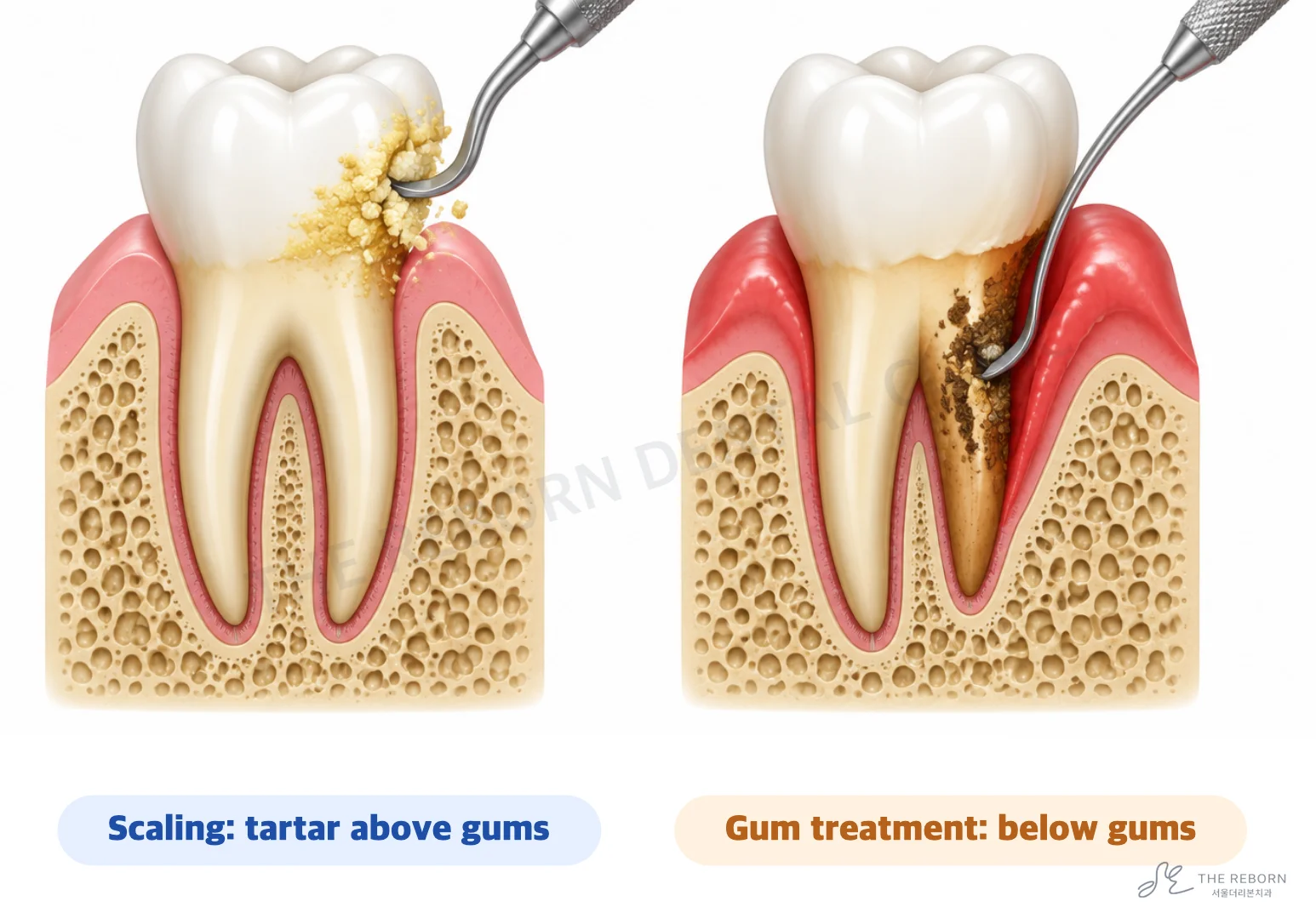
- Scaling removes tartar and plaque above the gums; gum treatment (deep cleaning) cleans the root surfaces below the gums.
- Treatment can be more uncomfortable than scaling, so deeper areas are often numbed; in one study, most people had no pain 24 hours afterwards.
- Teeth often feel sensitive to cold after treatment, and this tends to ease over time.
- Results are checked weeks to months later, and regular maintenance visits are needed after treatment.
How is gum treatment different from scaling?
Scaling mainly removes tartar and plaque from the parts of the teeth you can see above the gums.
Gum treatment goes one step further: it cleans away the bacterial film and tartar stuck to the root surfaces below the gums.
When periodontitis develops, the gap between the gum and the root gets deeper. This gap is called a periodontal pocket.
A toothbrush can't reach inside the pocket, so tartar is easily left there. That is why fine instruments are used to clean the root surface and make it smooth.
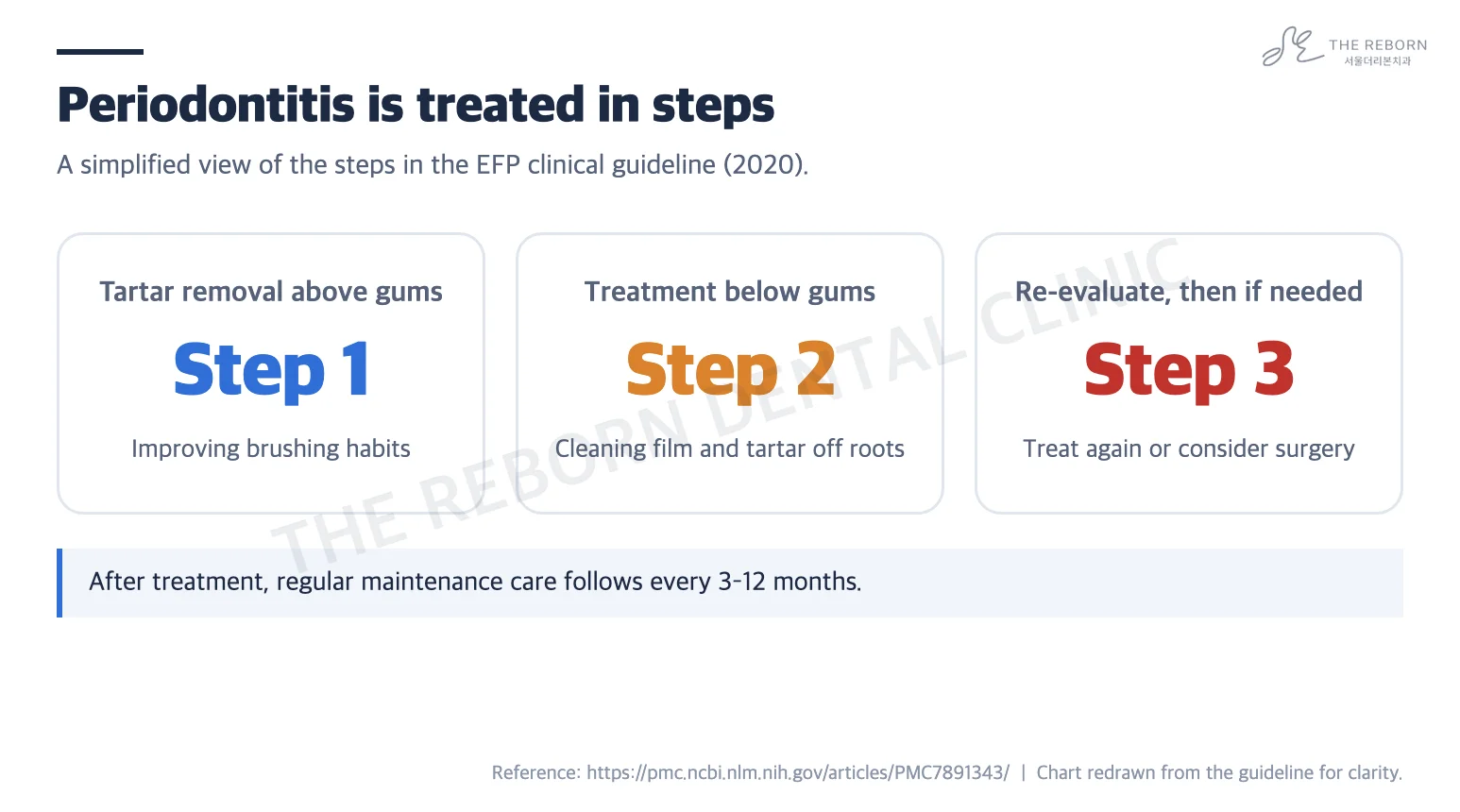
The 2020 clinical guideline of the European Federation of Periodontology (EFP) describes treatment in steps.
Hand instruments and ultrasonic instruments are used together as each situation requires.
The goal of treatment is gum pockets of 4 mm or less that don't bleed when they are measured.
So whether you need gum treatment is decided by measuring the depth of the pockets with a thin instrument marked in millimetres, and checking whether they bleed.
There are also different ways to divide up the treatment. In a Taiwanese study, the mouth was treated over four visits within one month, a quarter at a time. In an Italian study, the whole mouth was treated in one session lasting about 2 hours 20 minutes on average. These are examples from two studies, not a fixed schedule.
How painful is gum treatment?
Because the cleaning reaches below the gums, treatment can be more uncomfortable than scaling. That is why areas that need deep cleaning are often numbed first.
A 2023 review of 32 randomised trials explained that using an anaesthetic gel on the gums reduced pain during treatment by about half compared with a placebo gel. This figure combines several studies, so the effect may have differed from study to study.
In a 2026 randomised trial, 76 people were split between an anaesthetic gel and an anaesthetic injection. Pain during treatment was similar, but everyone in the gel group needed extra anaesthetic, compared with 24% in the injection group. The two groups differed in how advanced their gum disease was, so the comparison has limits.
There is no single set method. The choice depends on how much of the mouth is treated and how deep the cleaning needs to go.
Pain after treatment tends to settle faster than many people expect. In a 2023 study that recorded pain at several points in time for 52 people after gum treatment, no one reported severe pain.
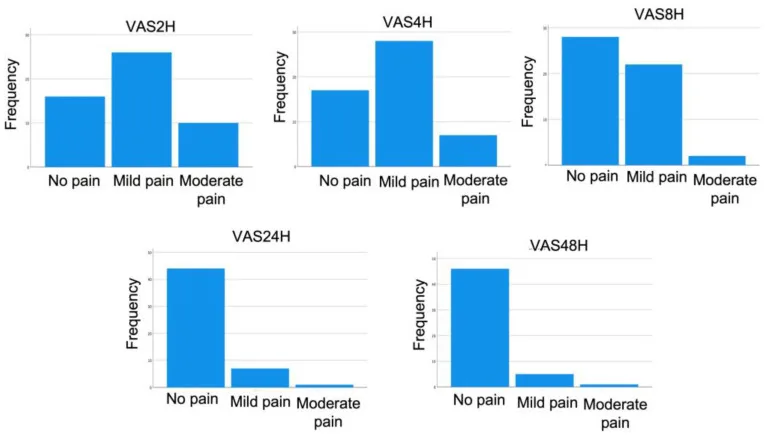
The average pain score fell from 0.88 out of 10 at 2 hours to 0.13 at 48 hours, and at 24 hours 84.6% said they had no pain. About one in five people (19.2%) took painkillers, and those who felt more tense and anxious tended to feel more pain.
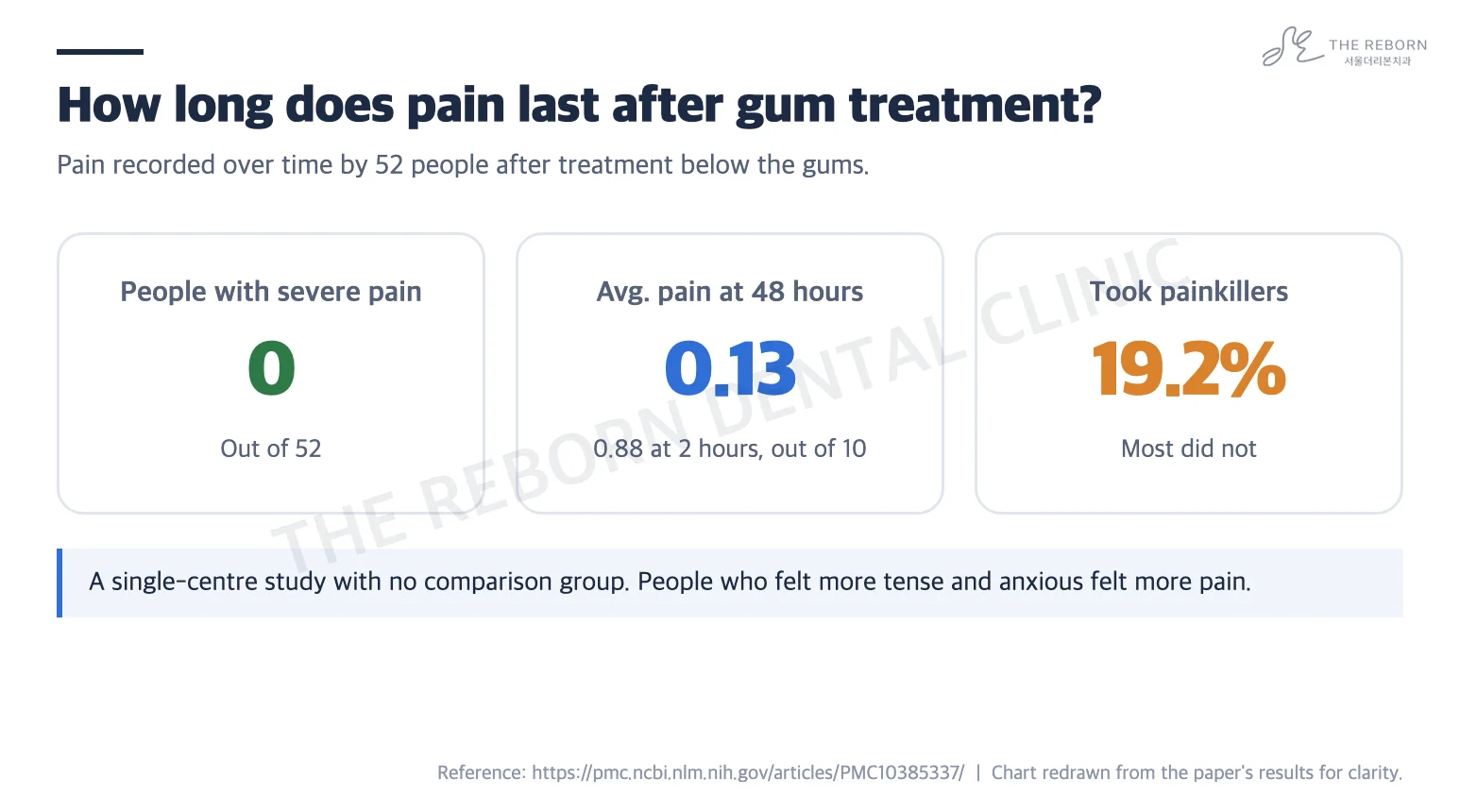
This was a study at one centre, with treatment done by specialists and no comparison group, so it can't be applied directly to everyone. Still, it suggests that many people feel comfortable again within a day or two after treatment.
If you had an anaesthetic, wait to eat until the feeling comes back. On the day of treatment, it's more comfortable to avoid spicy and hot food.
Why do teeth feel sensitive after treatment, and for how long?
A common question after gum treatment is about teeth feeling sensitive to cold water.
This happens because the tartar that covered the root surface comes off and the swollen gums shrink back, so a little more of the root is exposed.
In a 2012 systematic review, sensitivity the day after treatment below the gums was reported at rates of 62.5–90%, falling to 52.6–55% after one week.
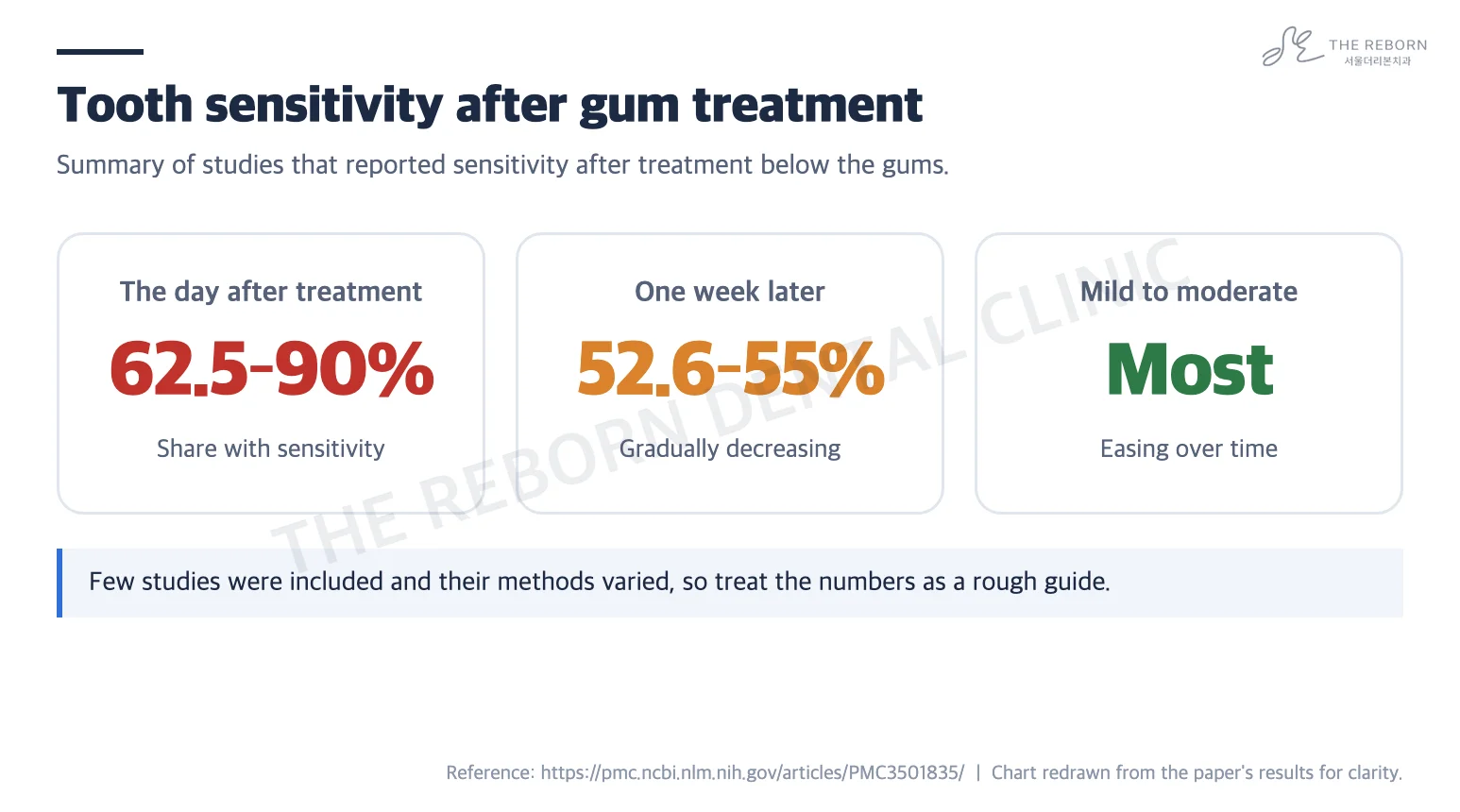
In most cases it was mild to moderate and eased over time.
Many studies reported that sensitivity was worst between a few hours and 2 weeks after treatment, and it was more common after treatment below the gums than after scaling above the gums.
Many of the studies were old and used different methods, so the numbers can't be taken at face value, but sensitivity right after treatment is a common reaction.
While your teeth are sensitive, use a toothpaste for sensitive teeth and avoid very cold food for a while. If it lasts a long time, the dentist may apply a treatment that covers the root surface.
In a 2020 randomised trial, patients with sensitivity after gum treatment used a toothpaste with an ingredient for sensitive teeth, and from 4 weeks on it helped a little more than the comparison toothpaste. It was a small, short trial of one toothpaste ingredient.
When and how are the results of gum treatment checked?
Right after treatment the gums are still healing, so the results aren't judged straight away.
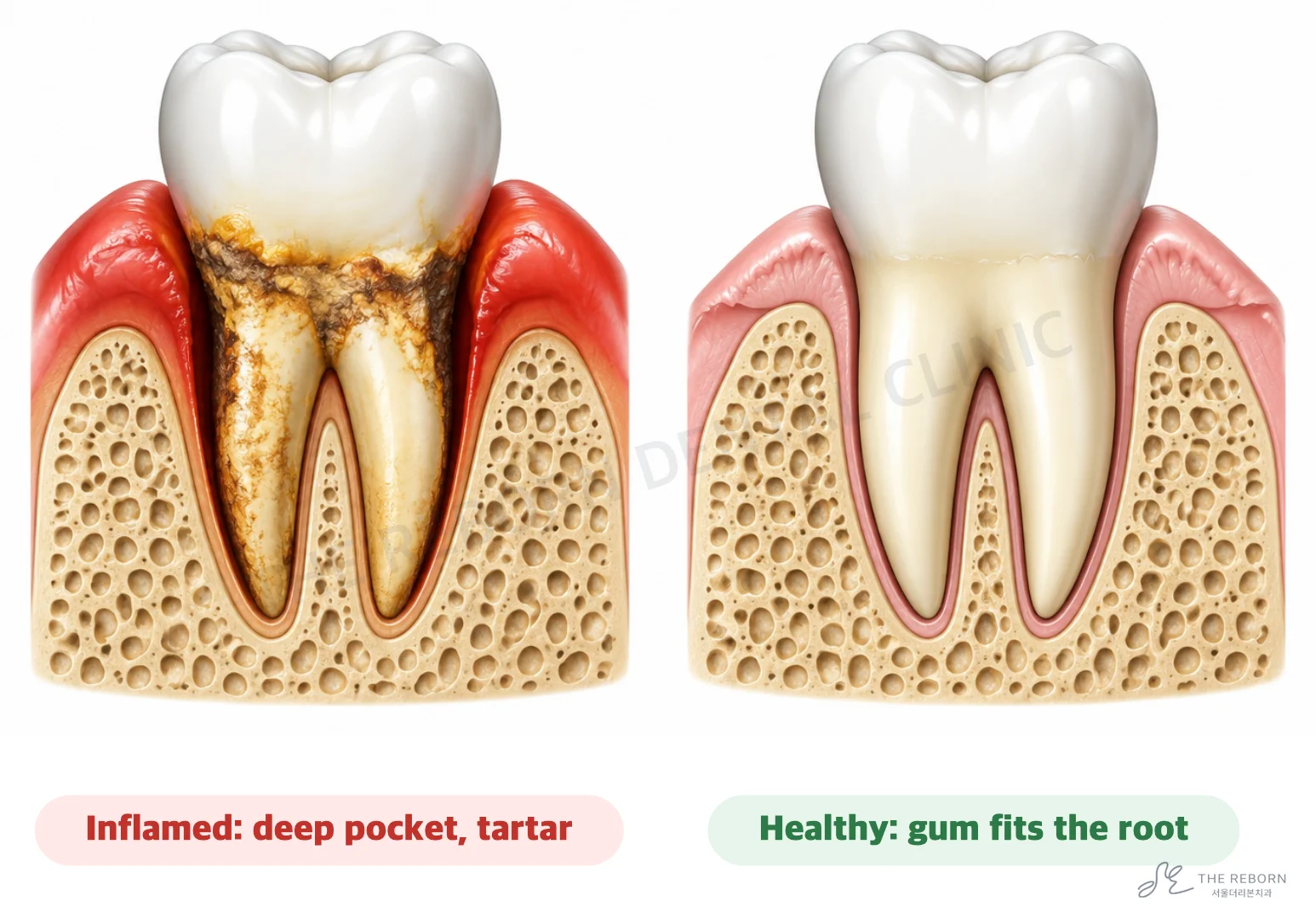
It is known that the gum takes about 2 weeks to reattach to the root and about 2 months to settle firmly. So the pocket depth is measured again, and bleeding is checked, weeks to months later.
In a 2026 randomised trial, when results were re-checked at 3 months or at 6 months, the share of sites that reached the goal was similar, at 68.5% and 71.9%, so waiting a little longer made little difference. It was a small trial at a single university clinic.
In the studies summarised in the guideline mentioned above, 6 to 8 months after treatment the pockets were on average 1.7 mm shallower, 74% of them reached the target state, and gum bleeding fell by 63%.
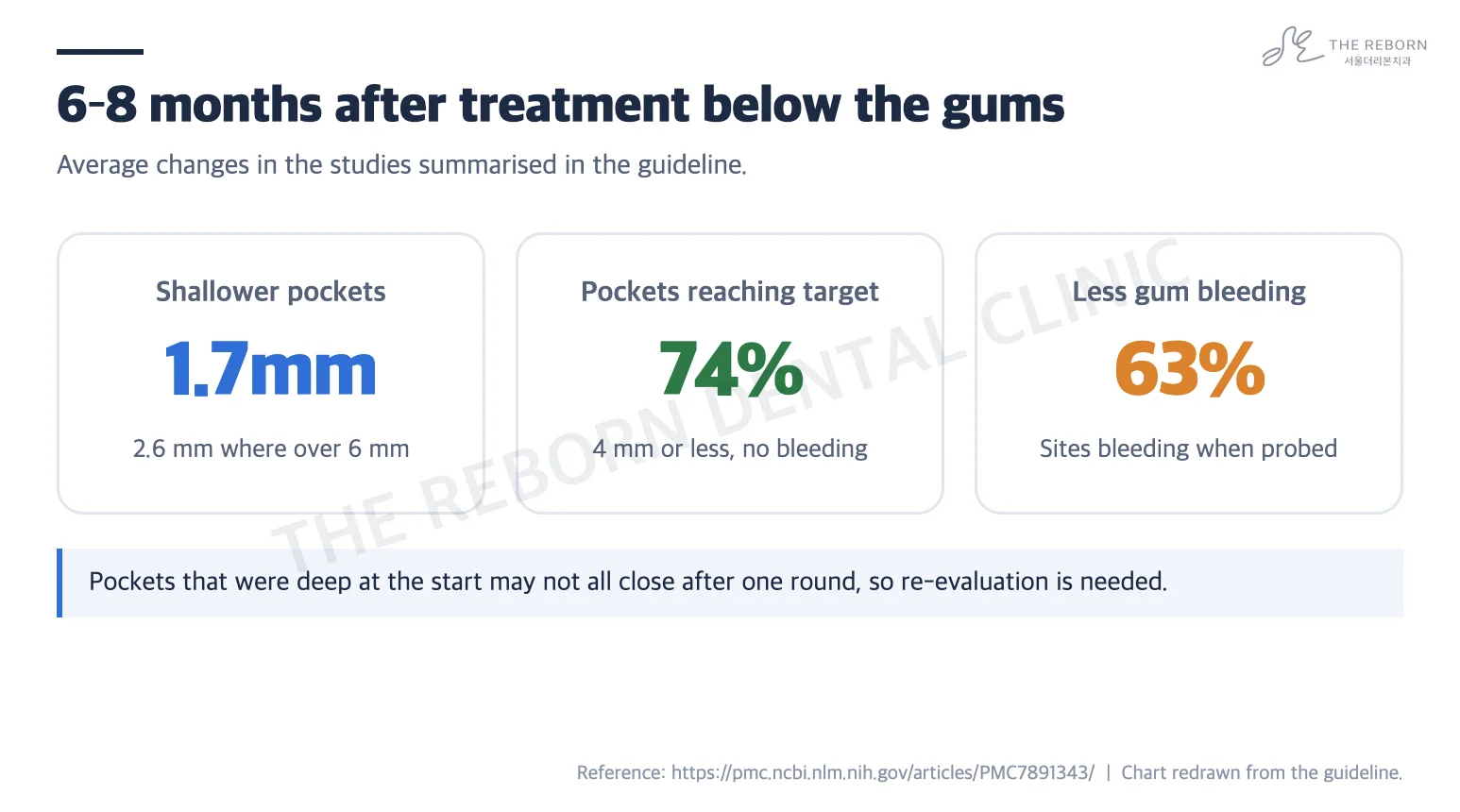
However, areas that were deep to begin with may not all close after one round of treatment.
In the 2026 randomised trial, only about half of the sites that were 6 mm or deeper at the start reached the goal. Molars, areas where the roots divide, and areas where plaque remained were also more likely to be left with deep pockets.
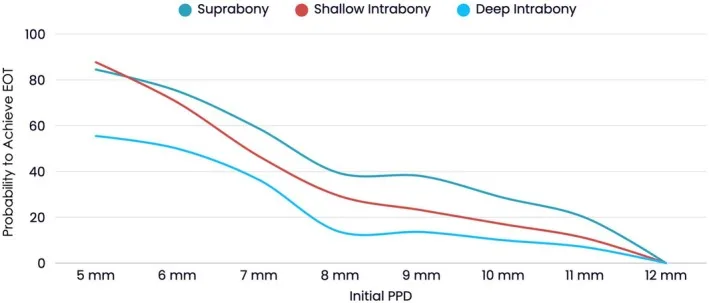
After the re-check, areas that are still 4–5 mm deep are treated below the gums once more, and for areas that remain 6 mm or deeper, surgery that opens the gum to clean the root may be considered.
A 2017 study also found that 9 mm pockets became shallower by an average of 3.97 mm on single-rooted teeth but 2.39 mm on teeth with several roots, so the back teeth improved more slowly. It was a small study of 15 people with a short follow-up.
In the 2026 study, the gum line moved down by an average of 0.6–0.8 mm after treatment. This change happens as the swelling goes down, so the teeth may look slightly longer.
Why do I need regular visits after treatment?
Even after gum treatment calms the inflammation, the bacterial film builds up again, so care doesn't stop when treatment ends.
The guideline also recommends maintenance care every 3 months to at most 12 months after treatment, depending on each person's risk.
A 2014 study at a university hospital in Korea followed 134 people for an average of 11 years after they finished gum treatment.
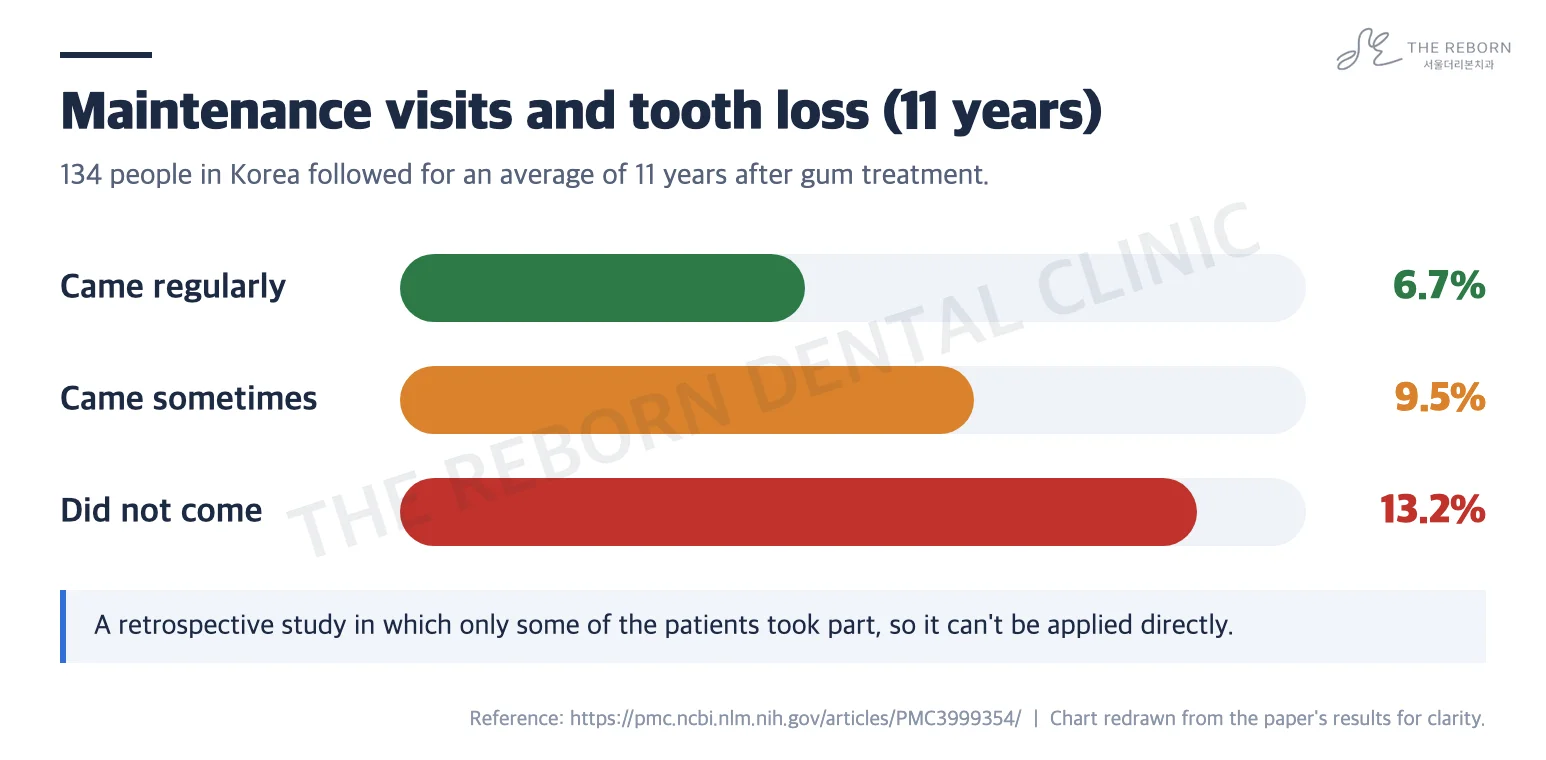
Looking only at teeth that were in good condition at the start, the group who kept coming lost 0.4% of them, and the group who did not come lost 5.1%.
A 2025 study that followed patients for an average of 19 years also found that each extra maintenance visit per year cut the risk of losing teeth by half. In the same study, people with diabetes or who smoked had about twice the risk of losing teeth.
Both were retrospective studies that analysed only the patients who took part, so the results can't be applied directly to everyone, but both show that regular care matters.
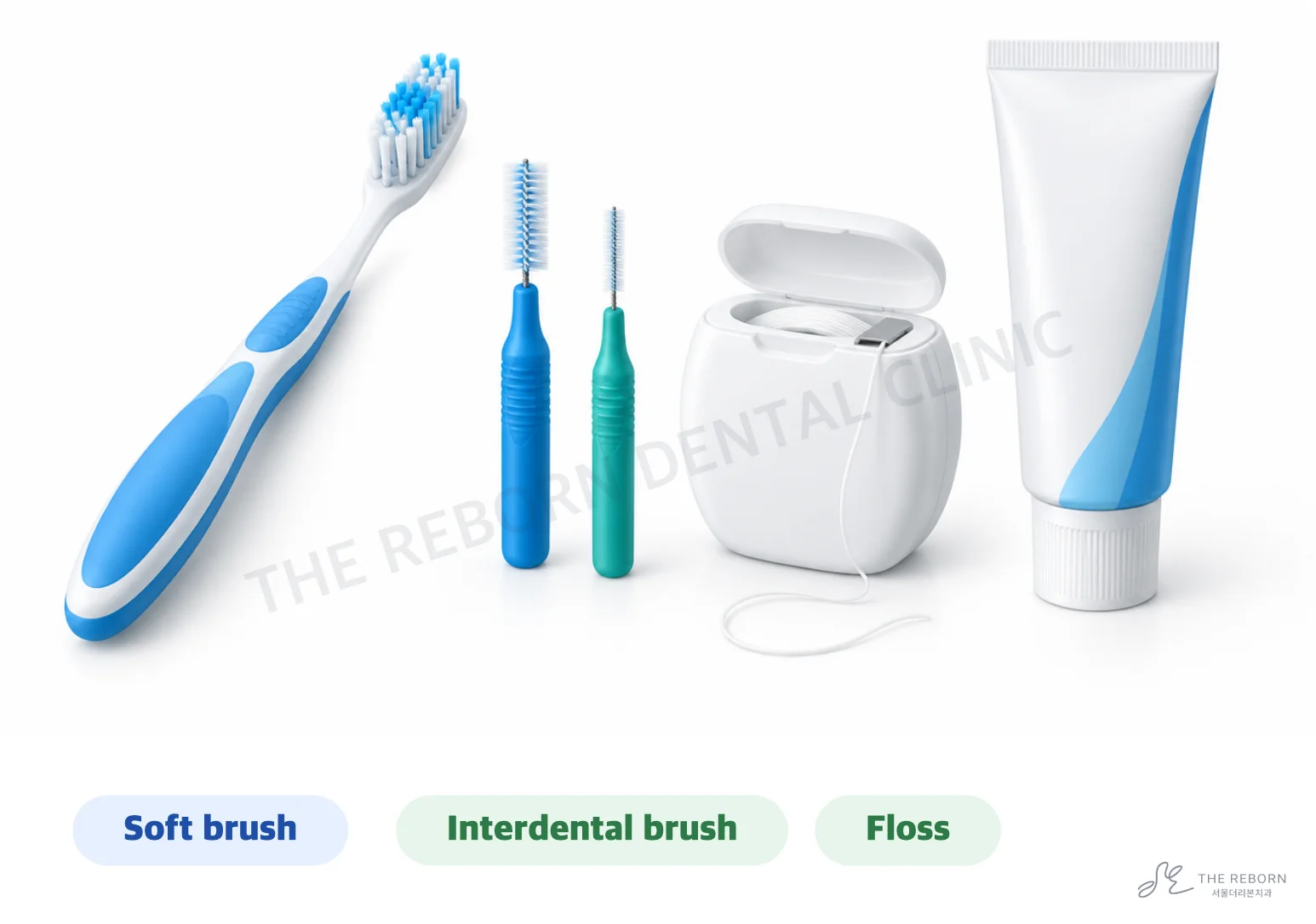
At home, use a soft toothbrush, clean between your teeth with interdental brushes or floss, and have your gums checked at the intervals you have been given.
Gum treatment is less a one-time treatment and more a process of treatment, re-checking and ongoing care.
Discomfort during treatment is reduced with anaesthetic, and pain and sensitivity after treatment usually ease within a few days to a few weeks.
At our clinic, we record the pocket depths and bleeding before and after treatment, and check together how well the gums have recovered.
If your gums often bleed when you brush or feel puffy and loose, it's better to have them checked than to put it off.
Email us at rbdent@naver.com and Dr. Park will reply personally. You can also call 031.225.1410 (+82-31-225-1410) during opening hours. We are near Suwon City Hall Station — directions.
- Treatment of periodontitis stages I–III — EFP clinical practice guideline (2020)
- Pain control in periodontal treatment — review of randomised trials (2023)
- Pain after scaling and root planing — observational study (2023)
- Tooth sensitivity after periodontal treatment — systematic review (2012)
- Timing of re-evaluation after non-surgical treatment — randomised trial (2026)
- Maintenance care and tooth loss in Korean adults — retrospective study (2014)
- Maintenance visits and long-term tooth loss — retrospective study (2025)
- Toothpaste for sensitivity after periodontal treatment — randomised trial (2020)
- Anaesthetic gel vs injection during periodontal treatment — randomised trial (2026)
- Pocket depth changes after non-surgical treatment — clinical study (2017)
- Initial pocket depth and treatment outcome — observational study (2020)
This article is general health information about the process, pain, recovery and aftercare of non-surgical gum treatment, not a diagnosis. The treatment method, number of visits and amount of pain depend on how advanced the periodontitis is, which areas are affected and your general health. Research results describe what was observed under each study's conditions and do not guarantee any individual outcome.