26 November 2026 · 7 min read
Dry Socket After Wisdom Tooth Extraction: When the Pain Gets Worse Again
By Dr. Park Junsun, Korean board-certified specialist in Integrated Dentistry
Hello, I'm Dr. Park Junsun, director of The Reborn Dental Clinic in Suwon.
After a wisdom tooth is taken out, it is normal for it to hurt for a day or two and then slowly get better.
But if the pain gets worse again around the third day and throbs up towards your ear, it could be a dry socket.
Many people have heard the name but aren't sure exactly what it is, or whether it heals on its own.
This article explains why dry socket happens, who is more likely to get it, how to lower the risk, and how it is treated and how long it lasts.
- Dry socket is when the blood clot in the socket breaks down or comes out early, leaving the bone exposed.
- A typical sign is pain that was easing and then gets worse again around 2–4 days after the extraction.
- Difficult surgery, birth control pills, smoking and uncontrolled diabetes have been linked to a higher risk.
- Treatment usually means gently rinsing the socket and placing a medicated dressing; in studies, pain fell a lot within a few days.
How is dry socket different from normal pain after an extraction?
After a tooth is taken out, blood fills the socket and clots. This blood clot covers and protects the wound.
If the clot breaks down or falls out too early, leaving the jawbone exposed, it is called a dry socket.
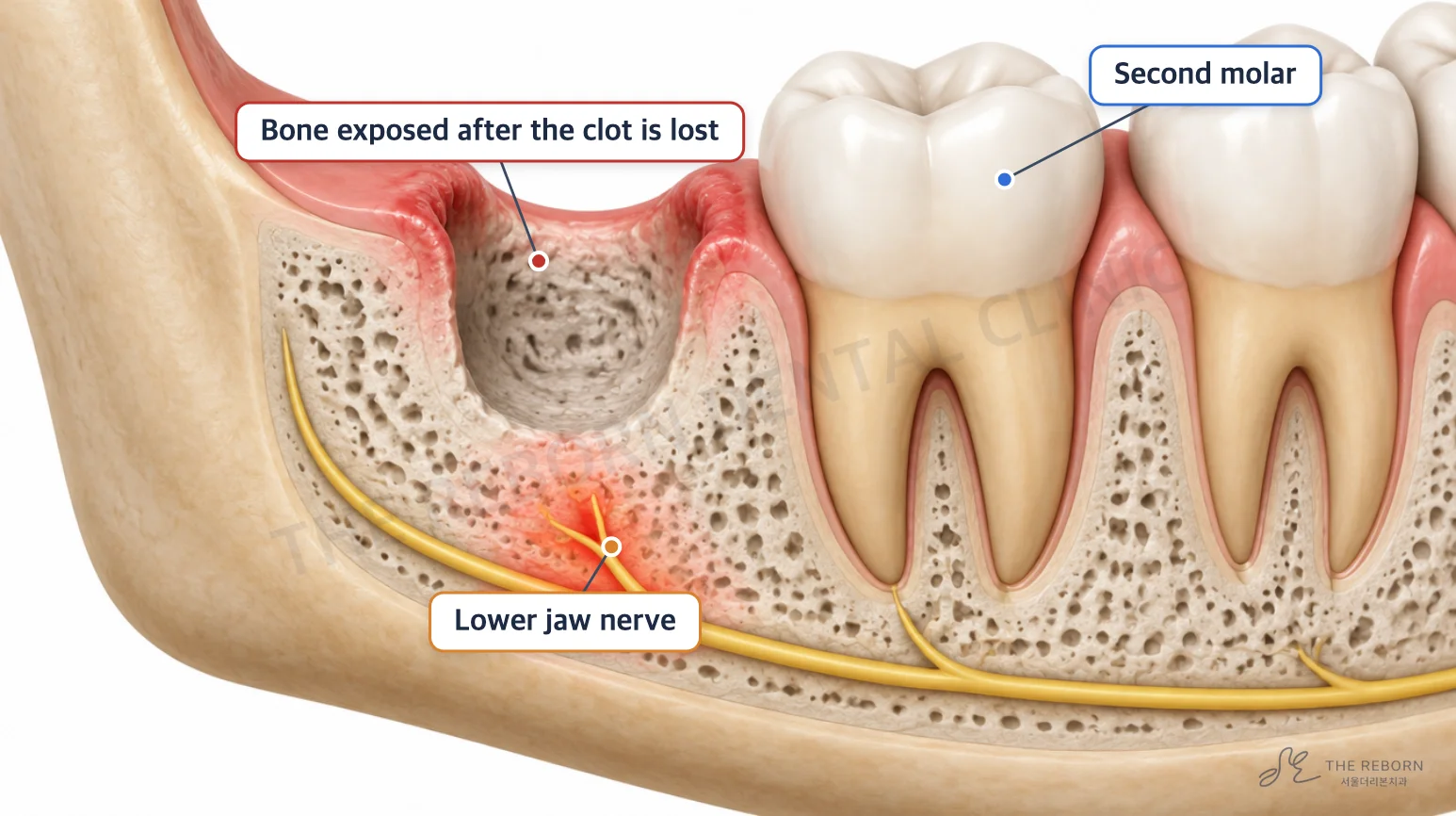
Normal pain after an extraction is usually worst on the first day and then gradually eases.
With a dry socket, the typical pattern is that pain which was easing gets worse again around 2 to 4 days after the extraction.
If you look at the socket, you may see an empty hole or greyish bone instead of a dark red clot.
Throbbing that spreads towards the ear or temple, bad breath and an unpleasant taste can also come with it.
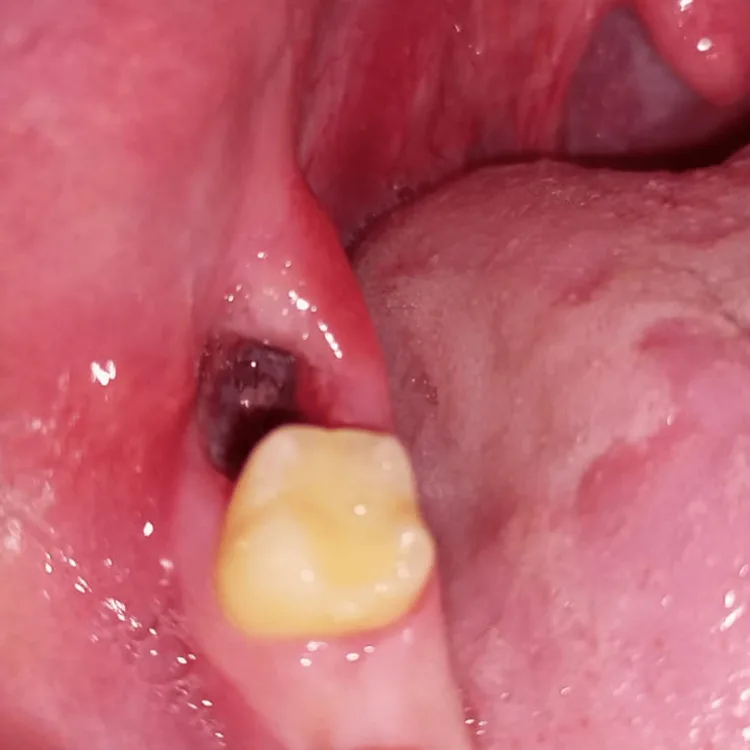
A 2024 study of 1,357 routine extractions treated moderate or worse pain lasting more than two days as a warning sign.
On the other hand, fever, pus or swelling that keeps getting bigger may mean an infection, and should be checked.
Who is more likely to get a dry socket?
Dry socket doesn't happen equally often after every kind of extraction.
In the study above, it happened after about 1% of routine extractions. Higher rates are reported for lower wisdom teeth.
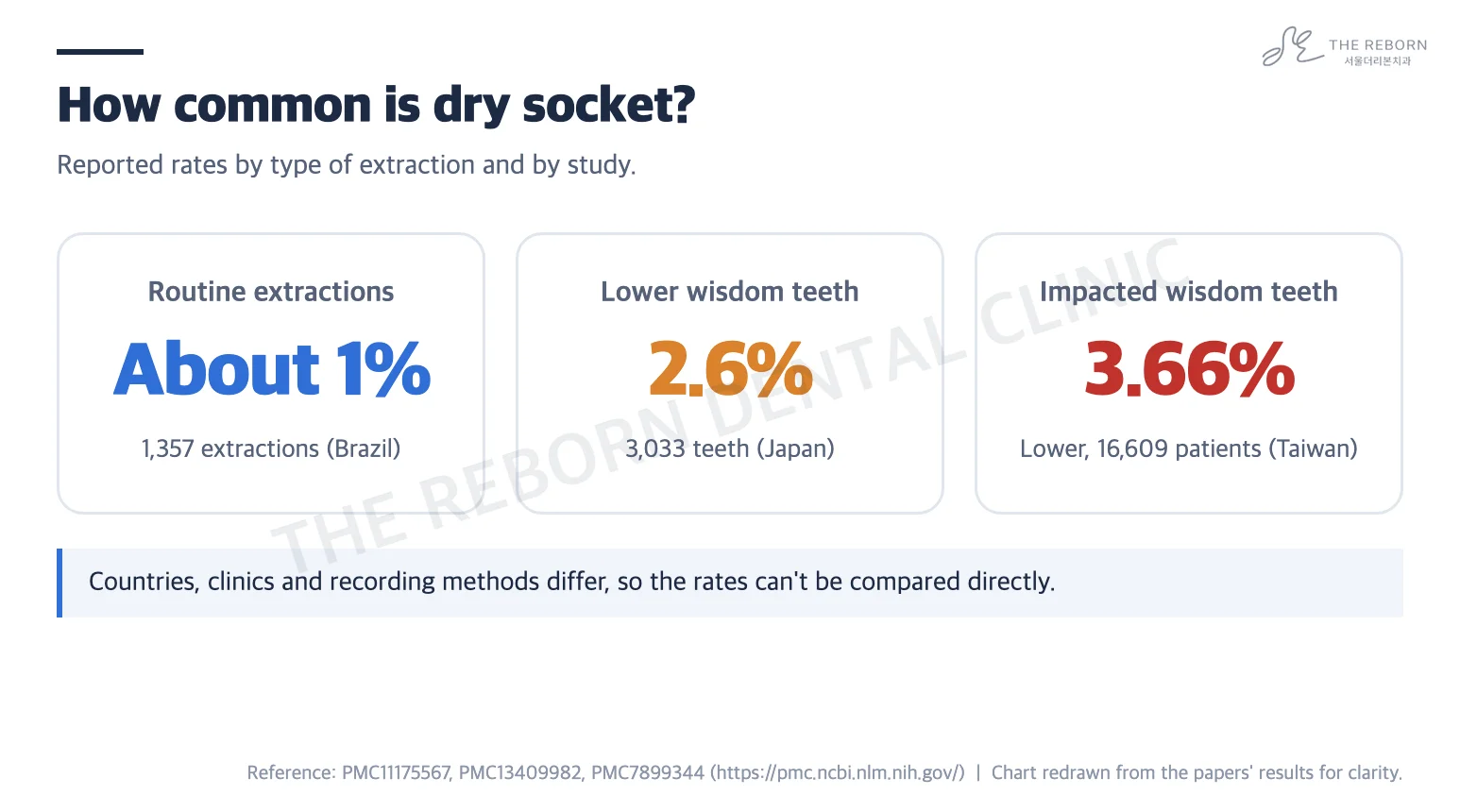
A 2021 study from Taiwan looked at 16,609 people who had an impacted lower wisdom tooth removed, and found that 3.66% had been treated for dry socket, according to insurance records.
The same study also reviewed 33 earlier studies. The reported rates varied widely, but half were below 6%.
Dry socket was more common after more difficult surgery, where bone had to be removed or the tooth divided. It was also slightly more common in people who had had gum inflammation around the wisdom tooth.
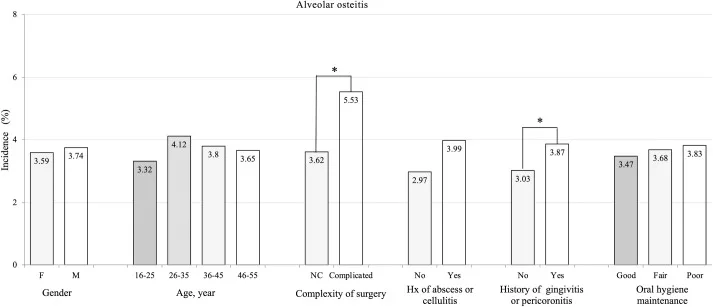
Birth control pills were also linked to it.
A 2026 study from Japan of 3,033 lower wisdom teeth found an overall rate of 2.6%, but 15.4% in people taking birth control pills.
A 2022 meta-analysis also found that women taking the pill had dry socket about twice as often as women who weren't.
A 2025 study from Australia of 2,343 extractions found that smoking raised the risk by about 2.6 times, and diabetes that was not well controlled by about 7.4 times.
However, results for age and sex differ between studies, so the risk can't be judged from any single factor. Most of these studies looked back at past records, so they show links rather than proof of cause.
Can dry socket be prevented?
There is no way to prevent it completely, but ways of lowering the risk have been studied.
A 2021 meta-analysis of 23 randomised clinical trials found that dry socket was roughly halved in groups that used a 0.12% chlorhexidine mouthwash or a 0.2% chlorhexidine gel.
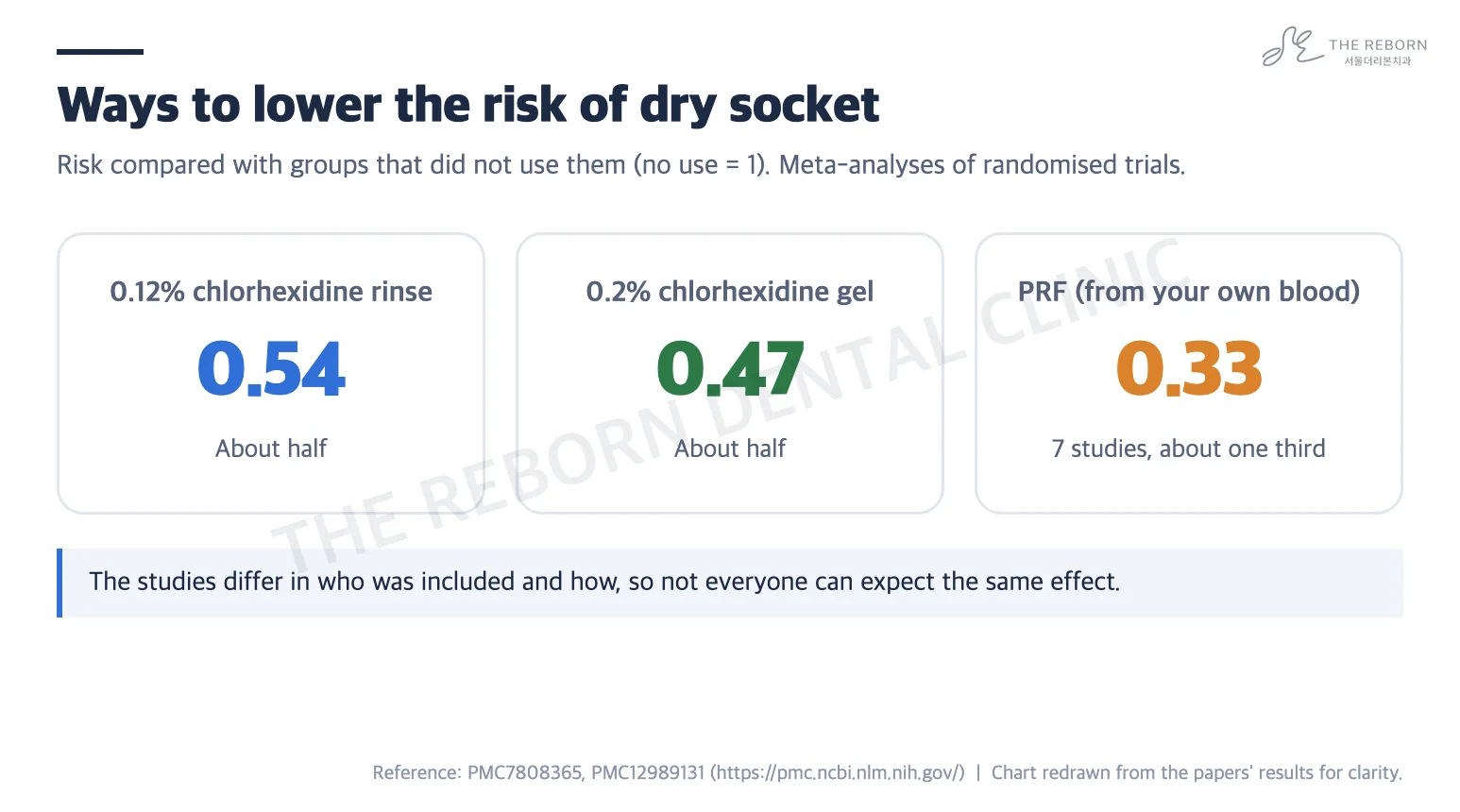
In 7 studies where PRF, a material made from the patient's own blood, was placed in the socket, the risk fell to about one third.
With preventive antibiotics, 25 people needed to be treated to prevent one case, and the quality of the evidence was low.
In the study of routine extractions (not wisdom teeth), 278 people needed antibiotics to prevent one case. So rather than being used for every extraction, antibiotics are decided according to each person's risk.
Chlorhexidine used for a long time can stain the teeth or make things taste bitter, so it is used only for the period you are told.
The studies differed in who they included and how they were done, so not everyone can expect the same effect.
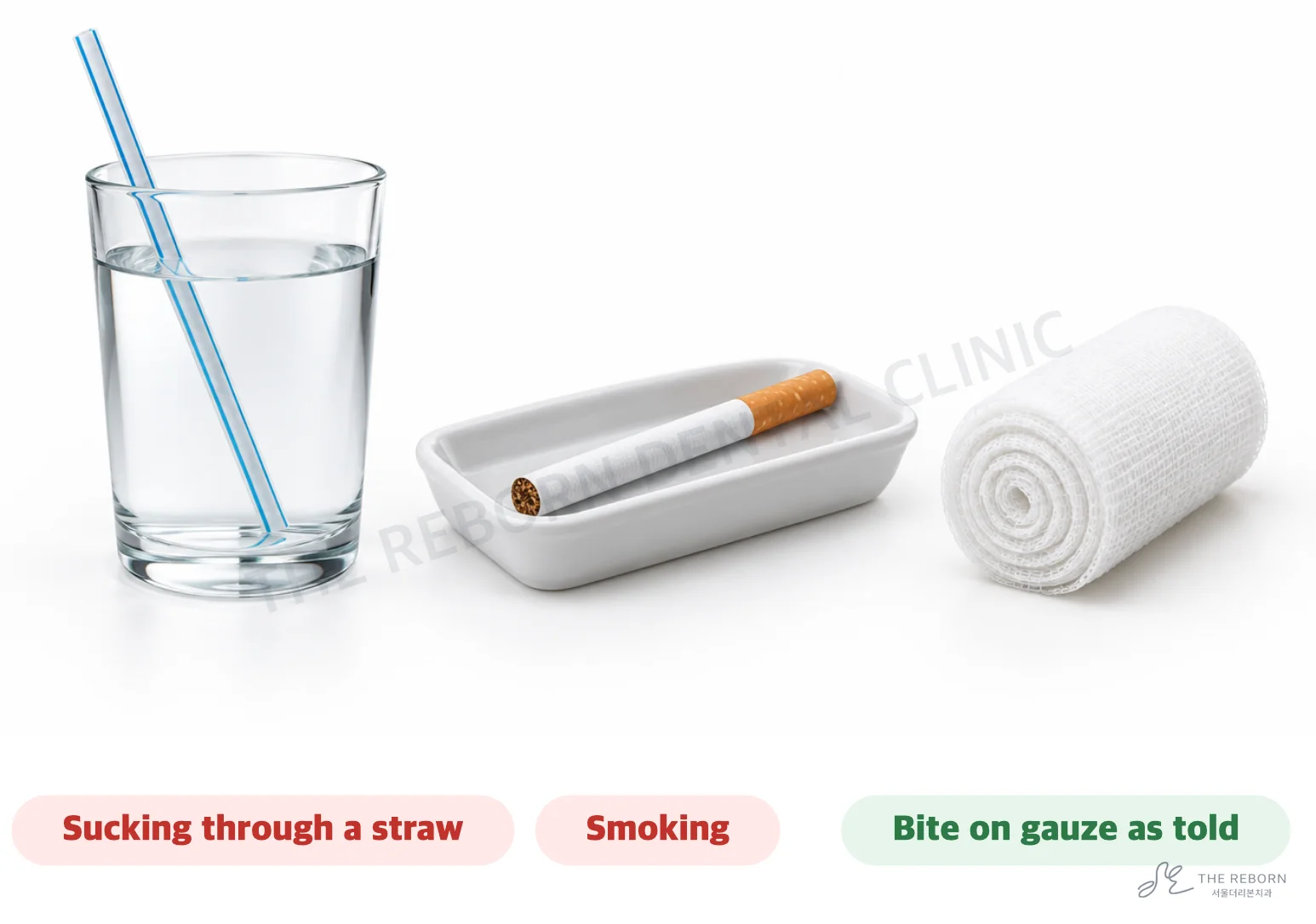
For the first few days after an extraction, try to avoid rinsing hard, sucking through a straw and smoking, so the clot doesn't come out.
If you take birth control pills, tell us before the extraction so that the timing and aftercare can be planned together.
How is dry socket treated, and how long does it last?
A dry socket is less an infection than pain from exposed bone being irritated. So treatment focuses on easing the pain and covering the bone.
A common approach is to gently rinse the socket with saline and then place a medicated dressing containing a pain-relieving ingredient, to cover the exposed bone.
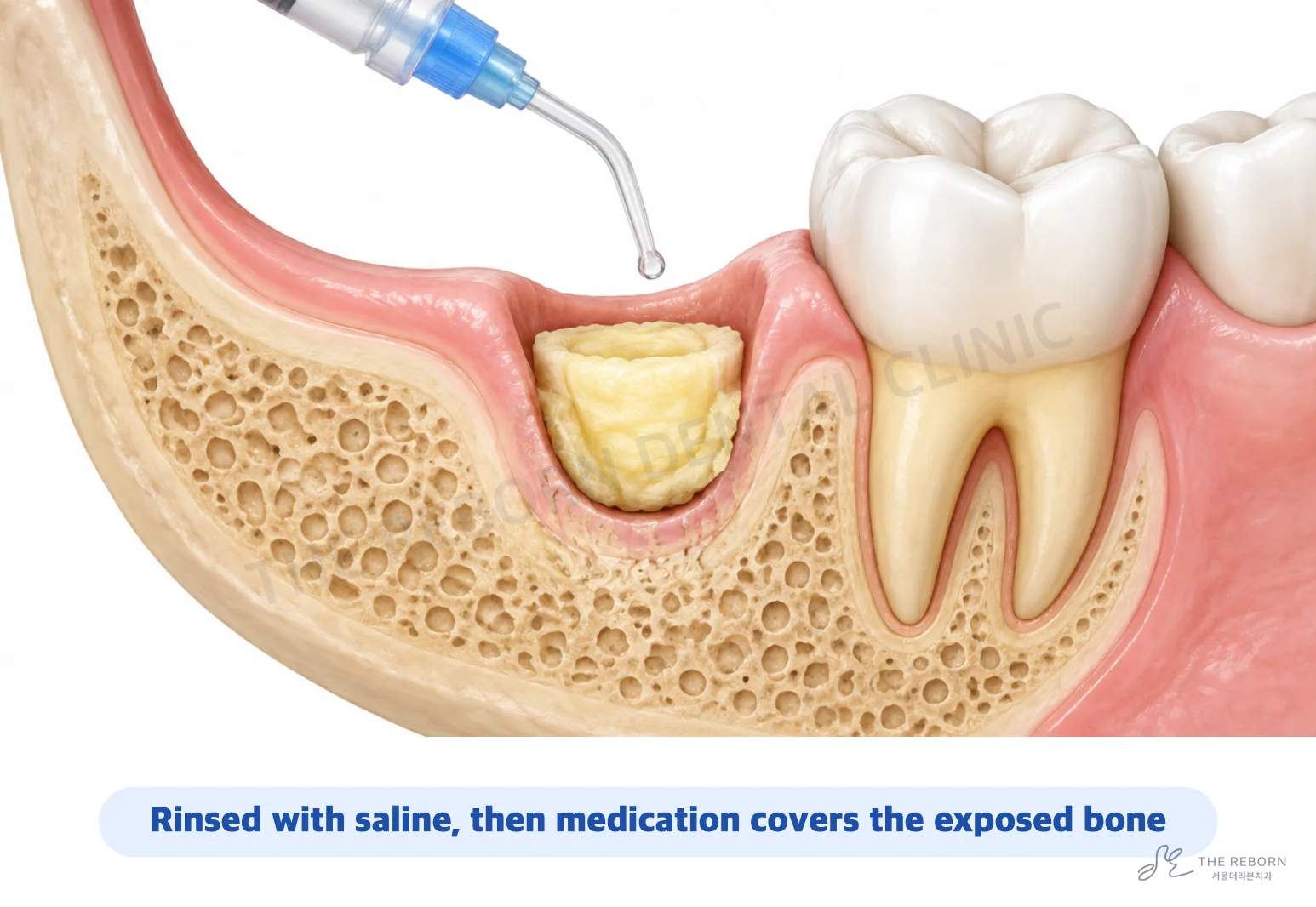
In a 2025 randomised clinical trial of 36 patients, pain in the group treated with this kind of dressing fell from 7.4 out of 10 to 1.6 after 48 hours and 0.3 after 72 hours.
The dressing was changed about 3 times on average, and patients took a little under 4 painkiller tablets on average during that time.
It was a small study at a single centre, so the results can't be applied directly to everyone. Still, it shows that pain often eases a lot within a few days of treatment.
In a 2024 randomised clinical trial that divided 80 patients among four treatments, pain in the group with the same dressing fell from about 7 on the day of treatment to 5.15 on day 2 and 1.5 on day 7. This was also a small single-centre trial, and smokers and people taking birth control pills were not included. So the speed of improvement differed between studies.
Symptoms are generally said to last about 7–10 days, so having treatment and being followed up is easier than waiting it out.
Dry socket appears a few days after the extraction rather than straight away, so many people simply put up with it.
If pain that was easing gets worse again, or throbbing continues for more than two days even with painkillers, the first step is to have the socket checked.
Even when the pain feels the same, treatment can differ depending on whether it is a dry socket or an infection.
Rather than putting up with it, have the wound checked at the dental clinic where your tooth was taken out.
Email us at rbdent@naver.com and Dr. Park will reply personally. You can also call 031.225.1410 (+82-31-225-1410) during opening hours. We are near Suwon City Hall Station — directions.
- Dry socket after routine extractions — prospective multicentre study (2024)
- Dry socket clinical photo — small clinical study, figure source (2023)
- Dry socket after impacted lower wisdom tooth removal — retrospective cohort study (2021)
- Dry socket and birth control pills after lower wisdom tooth removal — retrospective study (2026)
- Oral contraceptives and dry socket — meta-analysis (2022)
- Risk factors after tooth extraction — retrospective study (2025)
- Chlorhexidine for preventing dry socket — meta-analysis of randomised trials (2021)
- PRF for preventing dry socket — meta-analysis of randomised trials (2026)
- Preventive antibiotics and dry socket — commentary on a network meta-analysis (2024)
- Dressings for dry socket pain — randomised trial (2025)
- Four treatments for dry socket — randomised trial (2024)
This article is general health information about the symptoms, prevention and treatment of dry socket (alveolar osteitis) after wisdom tooth extraction, not a diagnosis. The cause of your symptoms and the right treatment can vary with the extraction site, the extent of surgery and your general health. Research results describe what was observed under each study's conditions and do not guarantee any individual outcome.