26 November 2026 · 9 min read
Front Tooth Crowns: What Affects a Natural Colour and Shape
By Dr. Park Junsun, Korean board-certified specialist in Integrated Dentistry
Hello, I'm Dr. Park Junsun, director of The Reborn Dental Clinic in Suwon.
Your front teeth are the first teeth people see when you smile or talk.
So when a front tooth crown is suggested, many people worry: will its colour be different from the teeth next to it? Will it look dark near the gum?
With back teeth, biting force comes first. With front teeth, colour, light and the gumline are more noticeable, so the points to consider are a little different.
Based on questions I often hear in my clinic, this article covers when a front tooth crown is considered, what helps it look natural in colour and shape, and how to look after it so it lasts.
- Small chips may only need resin or a veneer; a crown is considered when little tooth is left, a large filling covers several surfaces, or a root canal has weakened the tooth.
- Colour is matched with a shade guide, and photos can help reduce colour differences.
- Metal-ceramic crowns can make the gumline look dark because the metal shows through.
- Avoid biting hard things with front teeth, and clean the gum edge with floss.
When is a front tooth crown considered?
A chipped or discoloured front tooth does not always need a crown.
A small area can be filled with resin (tooth-coloured filling material). If covering mainly the front surface is enough, a veneer (often called a "laminate" in Korea) is considered first.
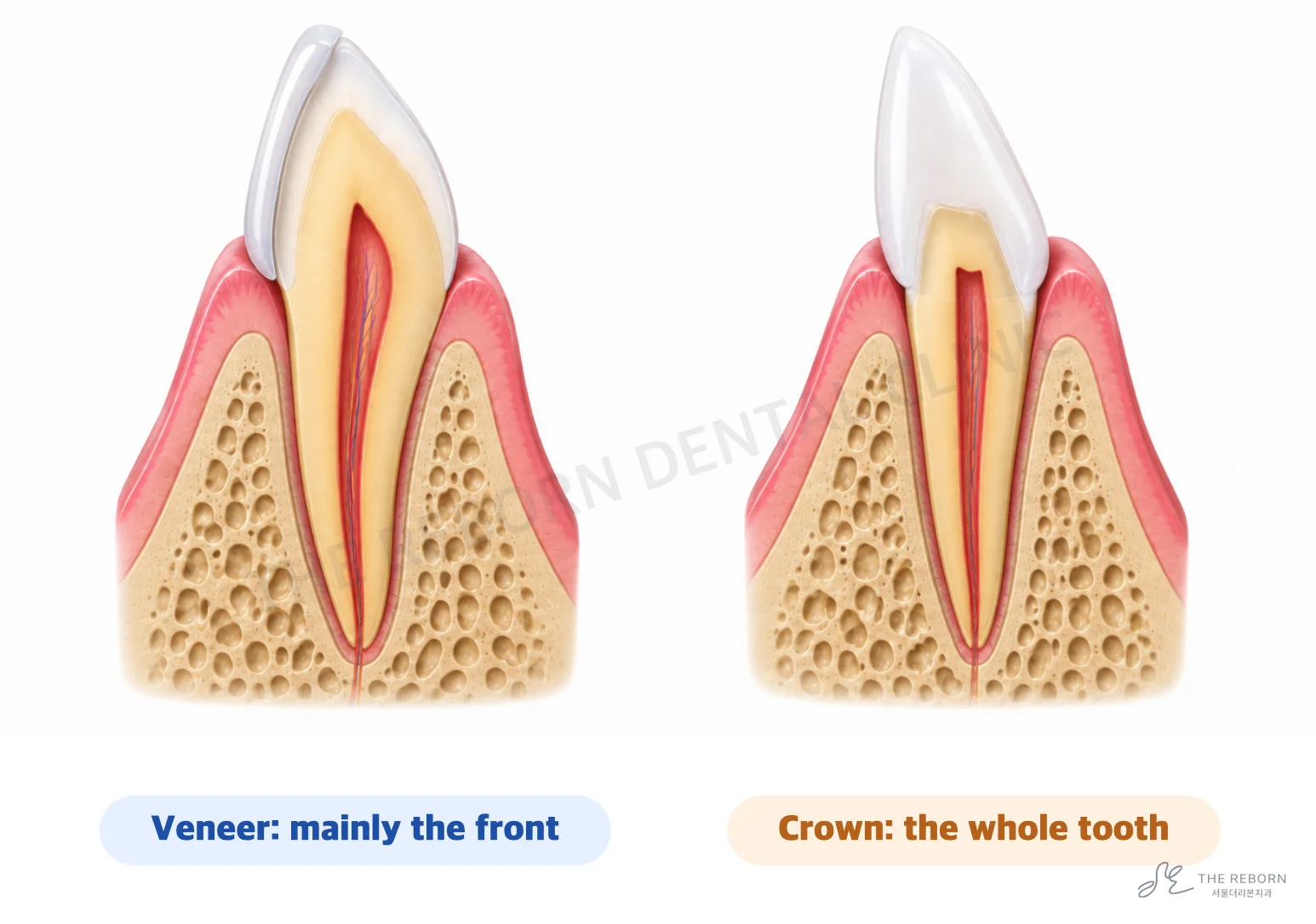
A crown wraps around the whole tooth, but in return more of the tooth has to be trimmed than for a veneer.
So a front tooth crown is considered when little of the tooth is left, when a large filling spreads over several surfaces, or when a root canal has made the tooth weaker.
| Option | What it covers | Usually considered when |
|---|---|---|
| Resin | Only the chipped or missing part | The area is small and enough tooth is left |
| Veneer (laminate) | The front surface and the biting edge | Changing shape and colour, with a fairly strong tooth |
| Crown | The whole tooth | Little tooth is left, or a root canal has weakened it |
This table is a general guide. In practice, the thickness of the remaining tooth and the direction of the bite are also taken into account.
A retrospective study published in 2021 looked at 263 front teeth that had had a root canal, restored with either resin or a crown.
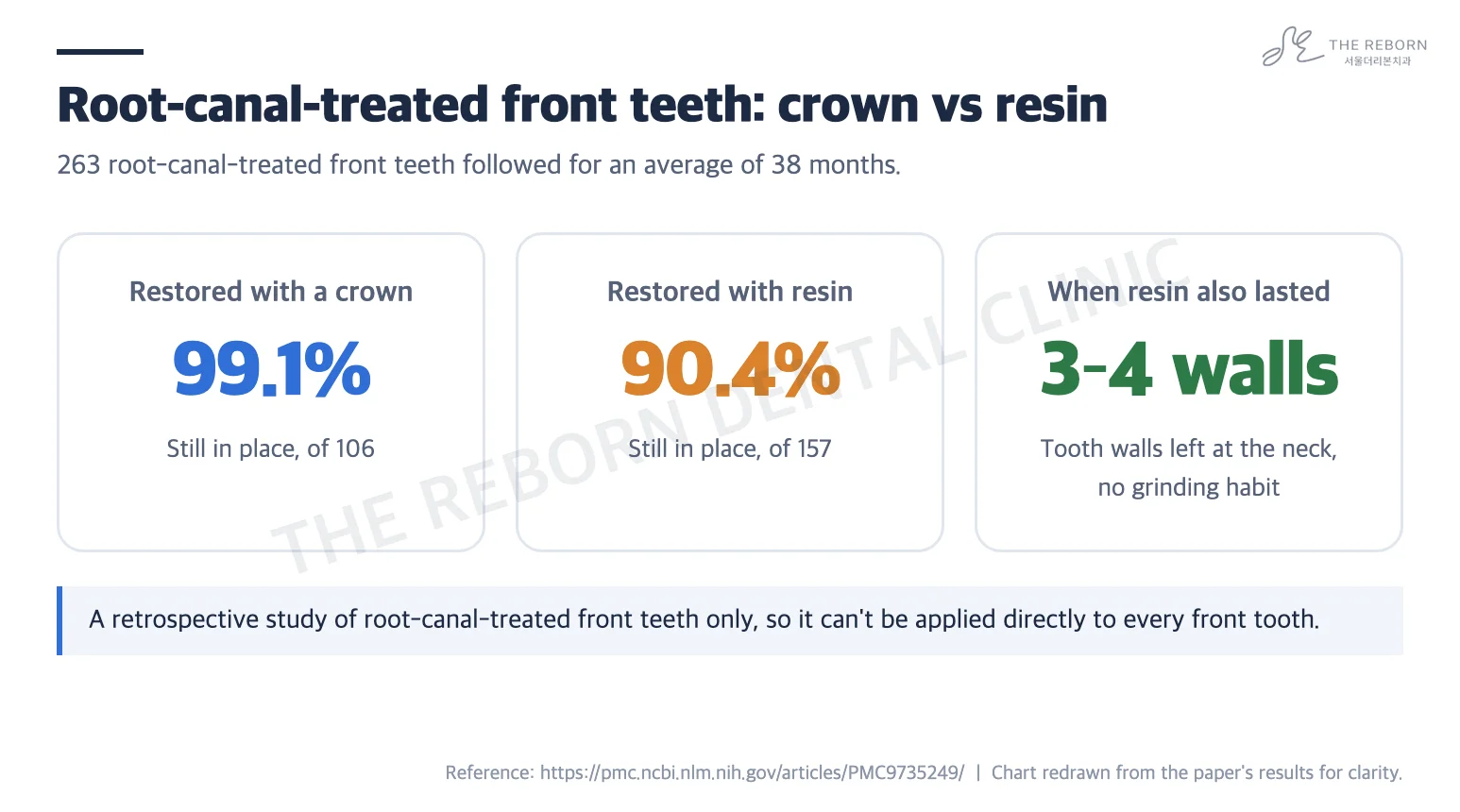
However, the same study found that resin can also last a long time when conditions are right, such as 3–4 walls of tooth remaining at the neck of the tooth and no habits like tooth grinding.
It was a retrospective study of root-canal-treated front teeth only, so it can't be applied directly to every front tooth. The basic rule is to decide based on how much tooth is left.
How is the colour matched to the teeth next to it?
The colour difference from neighbouring teeth is what people worry about most with a front tooth crown.
A natural tooth is not one single colour. It is a little deeper near the gum and becomes lighter and more translucent toward the tip.
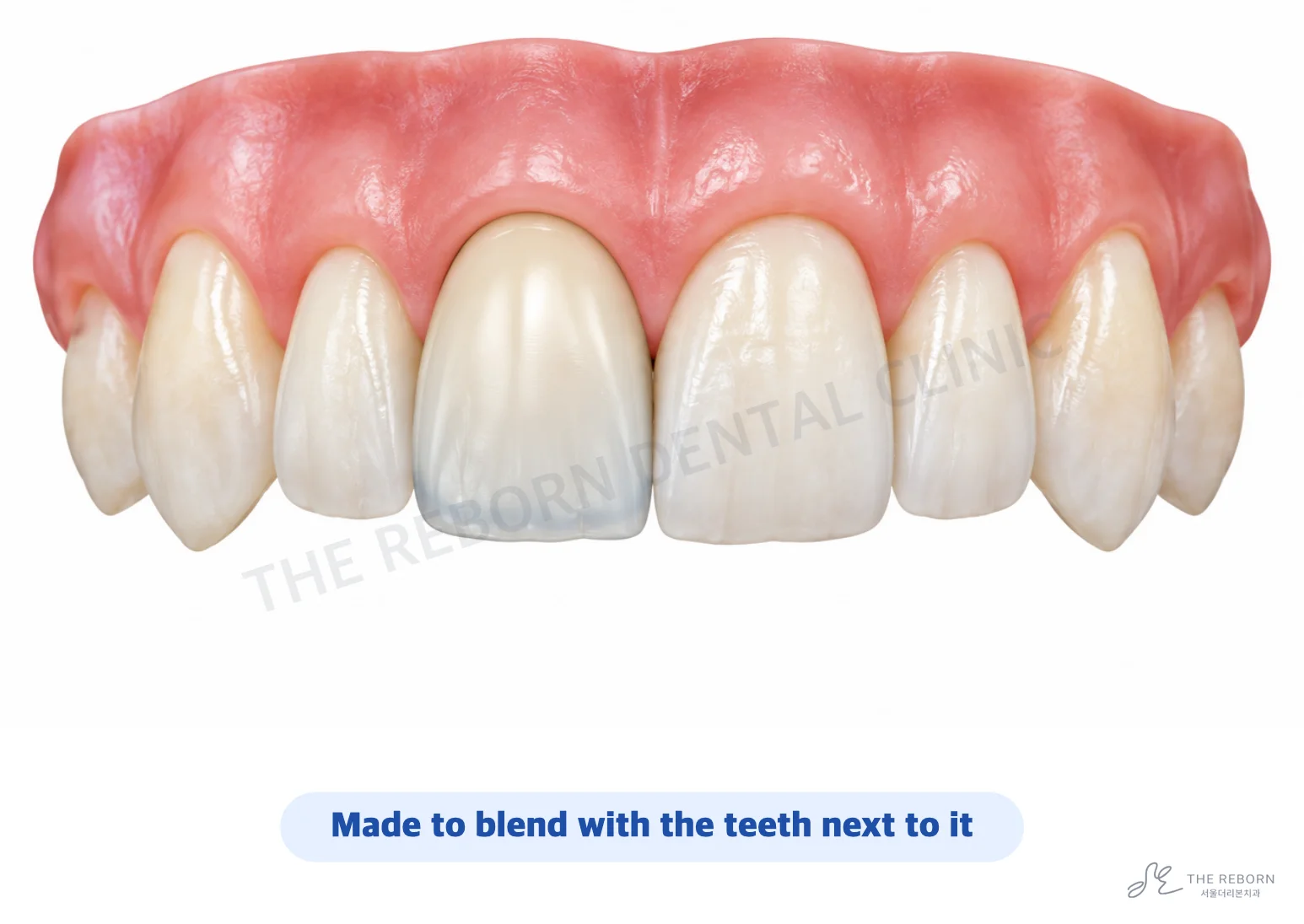
The colour is usually chosen by holding a shade guide next to the tooth. But the same colour can look different under different lighting or to different people.
A meta-analysis published in 2022 pooled 13 studies to compare ways of choosing the colour.
When digital photos were used together with the shade guide, the colour difference in the finished restoration was smaller than with the shade guide alone. Colour mismatches were also more common when only the shade guide was used.
More than half of the studies were laboratory studies, so the results can't be transferred directly. Still, recording the chosen colour in a photo and comparing it is a helpful step.
Teeth look lighter when they dry out, so it is better to check the colour early in the appointment.
Do crown materials let light through differently?
The tip of a natural front tooth lets a little light through, so it can look slightly bluish.
Crown materials also differ in how much light passes through them.
Zirconia is strong but fairly opaque, so in the past it had some drawbacks for front teeth.
A literature review published in 2024 brought together 53 laboratory studies on the translucency of newer zirconia.
It explained that even within zirconia, different types let through different amounts of light, and that the more translucent it is made, the lower its strength tends to be.
The review also included studies in which highly translucent zirconia at 0.8 mm thickness was similar to glass ceramic or to dentine (the layer under the enamel).
Some zirconia is made in layers, deeper near the gum and lighter toward the tip, to follow the colour change of a natural tooth.
However, all of these results were measured on test samples in a laboratory, so they may differ from how a crown looks in the mouth.
That is why front teeth may use layered-colour zirconia or glass ceramic, or have porcelain built up on the surface to bring out translucency.
In a 2023 study that evaluated 218 crowns, crowns with porcelain layered on the surface scored higher for colour match than crowns made from a single solid block.
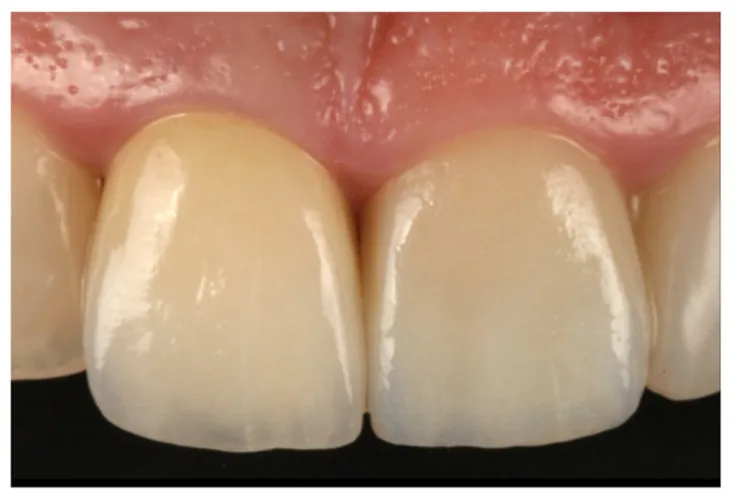
However, in that study the layered crowns were mostly on front teeth and the solid crowns mostly on back teeth, so the difference in tooth position is mixed into the result.
If the tooth underneath has darkened after a root canal, a very translucent material can let that dark colour show through. So the material and thickness are chosen after looking at the colour of the tooth underneath.
Why does the gumline around a crown look dark?
Some front tooth crowns made years ago look grey at the edge near the gum.
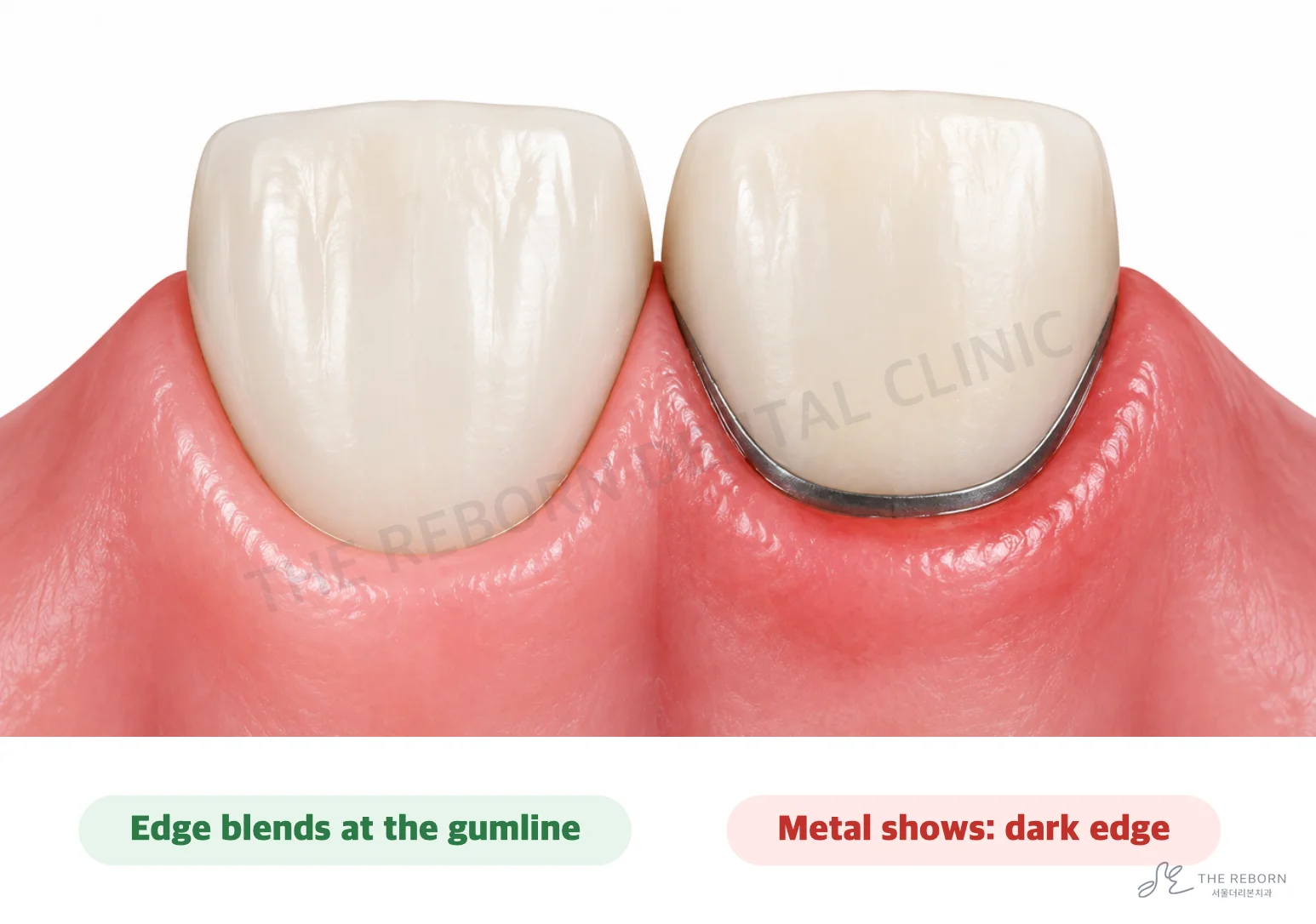
This is because a metal-ceramic crown has a metal frame inside, and the metal can show through and make the edge or the gum look dark.
A 6-year study published in 2023 placed a metal-ceramic crown and a glass ceramic crown in the same patients and compared them.
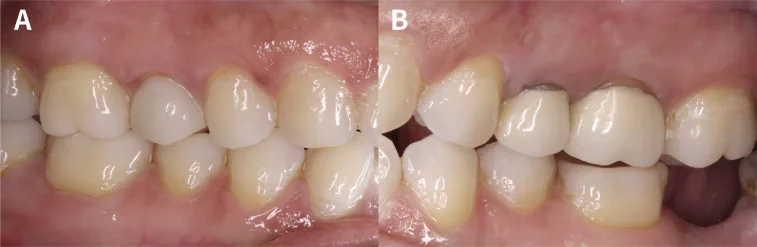
Over 6 years, 90.8% of the metal-ceramic crowns and 96% of the glass ceramic crowns were still in place, and no crown was remade because of how it looked.
This study looked at 25 pairs of crowns on back teeth, so it can't be applied directly to front teeth, but the way metal shows through is the same.
Some research has also found that the gums react differently depending on the material.
A 2025 study followed 20 patients with crowns on their upper front teeth for 6 months. The gum inflammation score was 0.9 for metal-ceramic and 0.2 for zirconia.
There was no difference at 1 week or 3 months, and the number of patients was small, so it can't be said that the material alone decides gum health.
The deeper the crown edge is placed under the gum, the more easily plaque is left behind, so the position of the edge is planned too.
Sometimes a temporary crown is worn first, to give the gum time to settle before the final crown.
In a 6-year study published in 2021, 74 teeth at the front of the mouth wore a temporary crown for 8–12 weeks to shape the gum before the final crown was fitted.
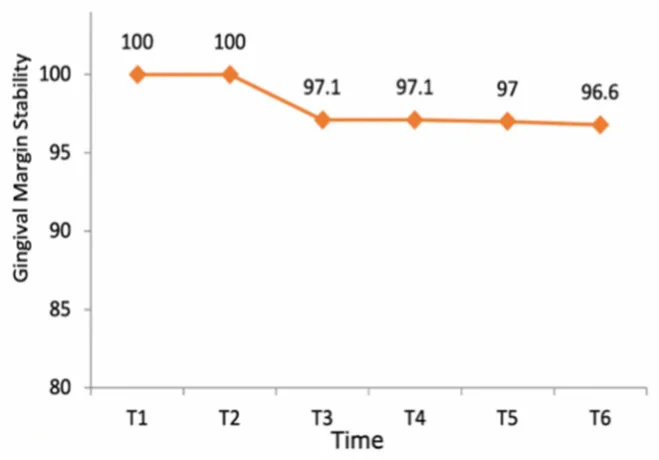
After 6 years, the gumline was still stable in 96.6% of teeth, and gum thickness had increased from an average of 1.26 mm to 1.68 mm after 2 years.
This was a single study of one specific shaping method with no comparison group, so it can't be said to be better than other methods.
How long does a front tooth crown last, and what should I be careful about?
How long a front tooth crown lasts is another common question.
A study published in 2016 followed 327 glass ceramic crowns, 176 of them on front teeth. After 48 months, 96.8% were still in place, and there was no clear difference in complication rates between front and back teeth.
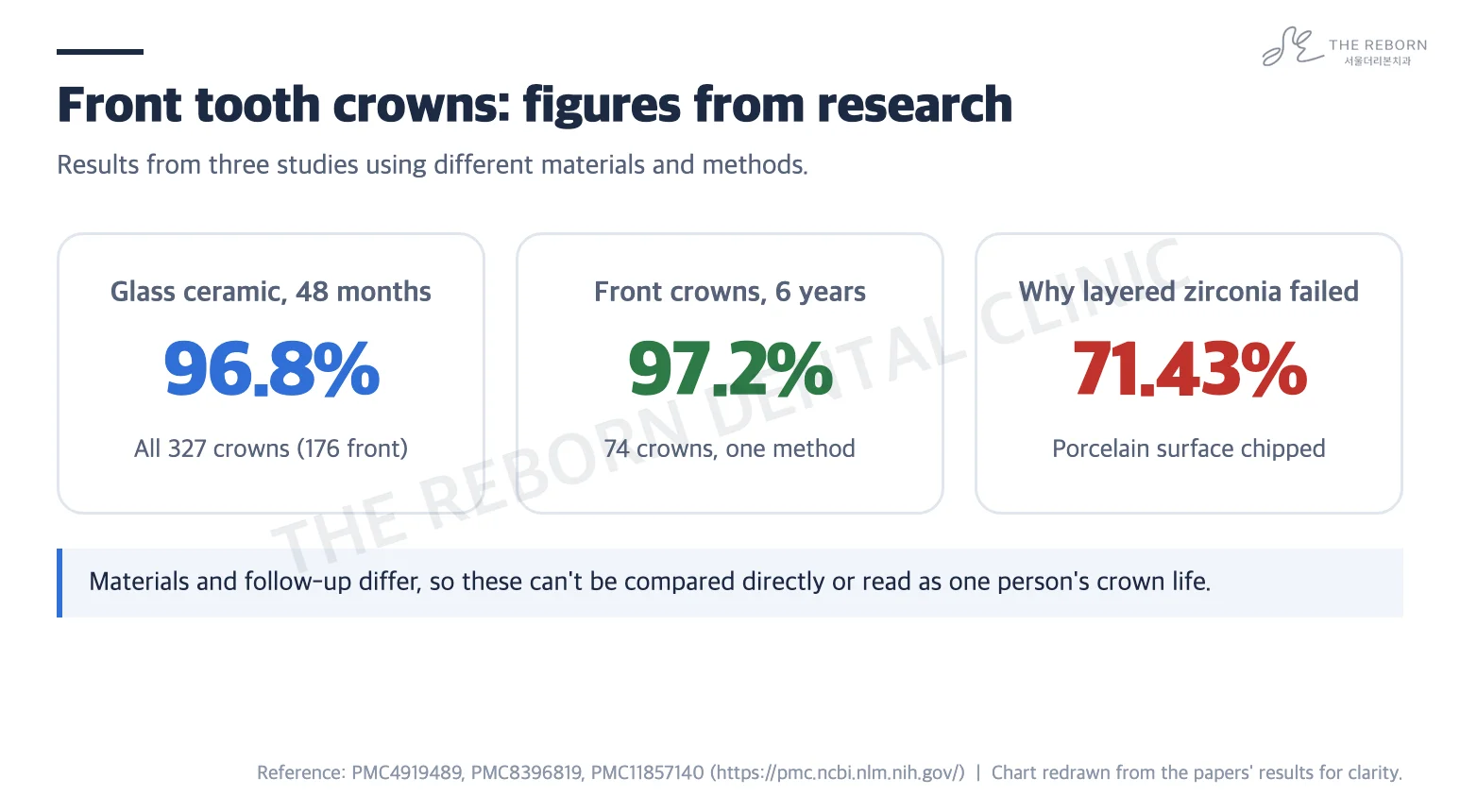
In the 6-year study above, 97.2% of the crowns were still in place.
The main thing to watch for is chipping of the surface layer. A 2025 study of 1,143 zirconia restorations found that, for restorations with porcelain layered on top, 71.43% of failures were caused by the porcelain surface chipping.
None of these studies followed patients for a very long time, and conditions differed between them, so they can't be read as how long any one person's crown will last.
A temporary crown is weaker than the final crown and can come off, so avoid sticky or hard food while you have one.
After the final crown is fitted, avoid biting through hard food with your front teeth or biting your nails or pens. If you grind your teeth, that should be managed too.
It is also important to floss so that plaque doesn't stay at the gum edge, and to have the gum depth checked at regular check-ups.
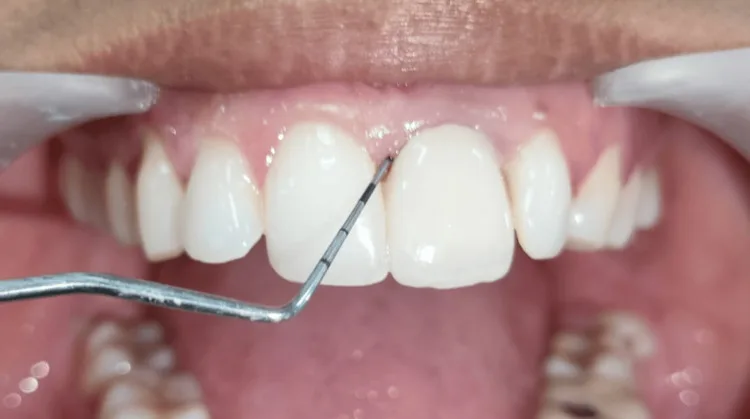
A natural-looking front tooth crown is not decided by the material alone.
The material and the position of the crown edge are chosen after looking at how much tooth is left, the colour of the tooth underneath, gum thickness and biting habits. At our clinic, we check the colour of the neighbouring teeth and the condition of the gums before deciding on a crown.
If a front tooth has broken, or an old crown looks dark near the gum, have the remaining tooth and gums checked rather than putting it off.
Email us at rbdent@naver.com and Dr. Park will reply personally. You can also call 031.225.1410 (+82-31-225-1410) during opening hours. We are near Suwon City Hall Station — directions.
- Resin versus crowns for root-canal-treated front teeth — retrospective study (2021)
- Methods for matching tooth colour — meta-analysis (2022)
- Translucency of newer zirconia — systematic review of laboratory studies (2024)
- Layered versus solid zirconia and glass ceramic crowns — retrospective study (2023)
- Glass ceramic versus metal-ceramic crowns — 6-year split-mouth study (2023)
- Front tooth zirconia crowns and the gumline — 6-year prospective study (2021)
- Glass ceramic crowns on front and back teeth — clinical follow-up study (2016)
- Solid versus layered zirconia restorations — retrospective study (2025)
- Gum health around metal-ceramic and zirconia front crowns — clinical study (2025)
This article is general health information about the materials, colour, gumline and care of front tooth crowns, not a diagnosis. Whether treatment is needed and which material is chosen depend on how much tooth is left, the tooth's colour, the condition of your gums, and your bite and habits. Research results describe what was observed under each study's conditions and do not guarantee any individual outcome.