26 November 2026 · 9 min read
How Long Does Dental Implant Treatment Take? A Step-by-Step Guide
By Dr. Park Junsun, Korean board-certified specialist in Integrated Dentistry
Hello, I'm Dr. Park Junsun, director of The Reborn Dental Clinic in Suwon.
One question that comes up in almost every implant consultation is how long treatment will take.
One person says theirs was done in three months; another says it took nearly a year. It is easy to be confused about which is right.
The length of implant treatment is not one fixed number. It depends on the condition of your bone, when the implant is placed, and when the crown is attached.
This article follows the questions patients often ask, and explains why each stage needs time and why the overall length can differ.
- Implant treatment goes through planning, placement, healing and the crown; healing takes up most of the time.
- The bone needs time to grow onto the implant, and the upper jaw, with its softer bone, may need longer.
- Placing an implant on the day of extraction or attaching a tooth soon after placement is possible only when conditions are right.
- Bone grafting, gum inflammation, and factors such as diabetes or smoking can make treatment longer.
What are the stages of implant treatment?
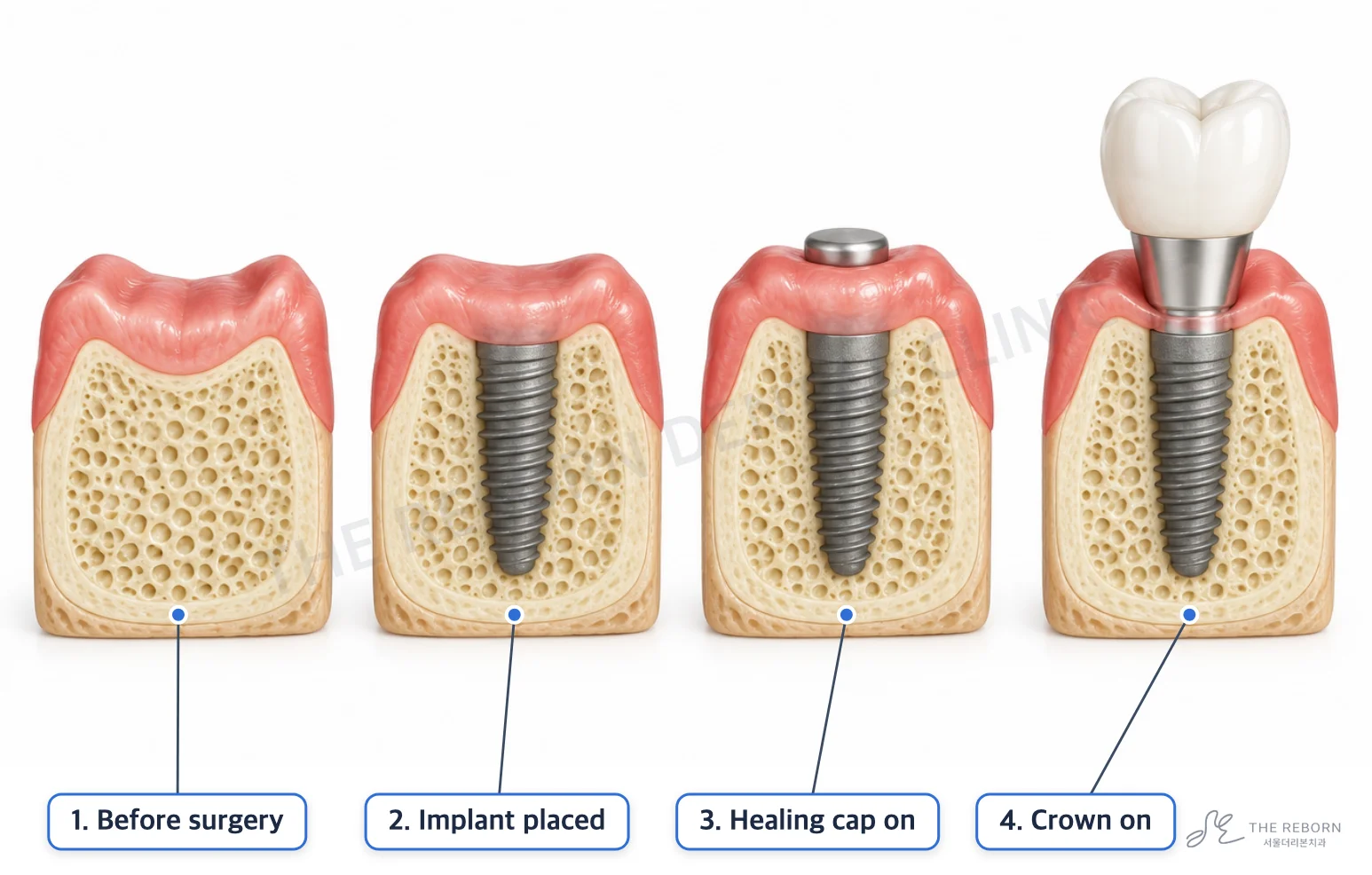
An implant is a treatment in which an artificial root is placed in the jawbone, and a tooth-shaped crown is attached on top of it.
It is not finished in a single day. It goes through several stages, one after another.
First, a CT scan is used to check the height and width of the bone and make a plan, and then the artificial root is placed.
Next comes a wait while the bone and the artificial root bond together. After that, the shape of the gum is prepared and the crown is attached.
| Stage | What happens | What affects the length |
|---|---|---|
| Diagnosis and planning | CT scan; checking the bone and gum | Whether an extraction or bone graft is needed |
| Placement | The artificial root is placed in the jawbone | How long after an extraction it is placed |
| Healing | Waiting for the bone and artificial root to bond | The amount and firmness of the bone |
| Crown | Taking an impression and attaching the tooth-shaped crown | Gum shape, adjusting the bite |
Most of the treatment time is taken up by the third stage, healing.
If the artificial root was covered under the gum while it healed, the gum is opened slightly before the crown stage, and a small post called a healing abutment (healing cap) is attached.
This is often called the "second surgery". The impression is taken after the gum has healed around the post and its shape has settled.
If the healing abutment is attached on the day the implant is placed, this separate step is not needed.
Why does it take time for the implant to bond with the bone?
Right after it is placed, the screw-shaped body of the implant is held in place by the grip of the bone around it.
Over time, new bone grows onto the surface of the implant. This process is called osseointegration.
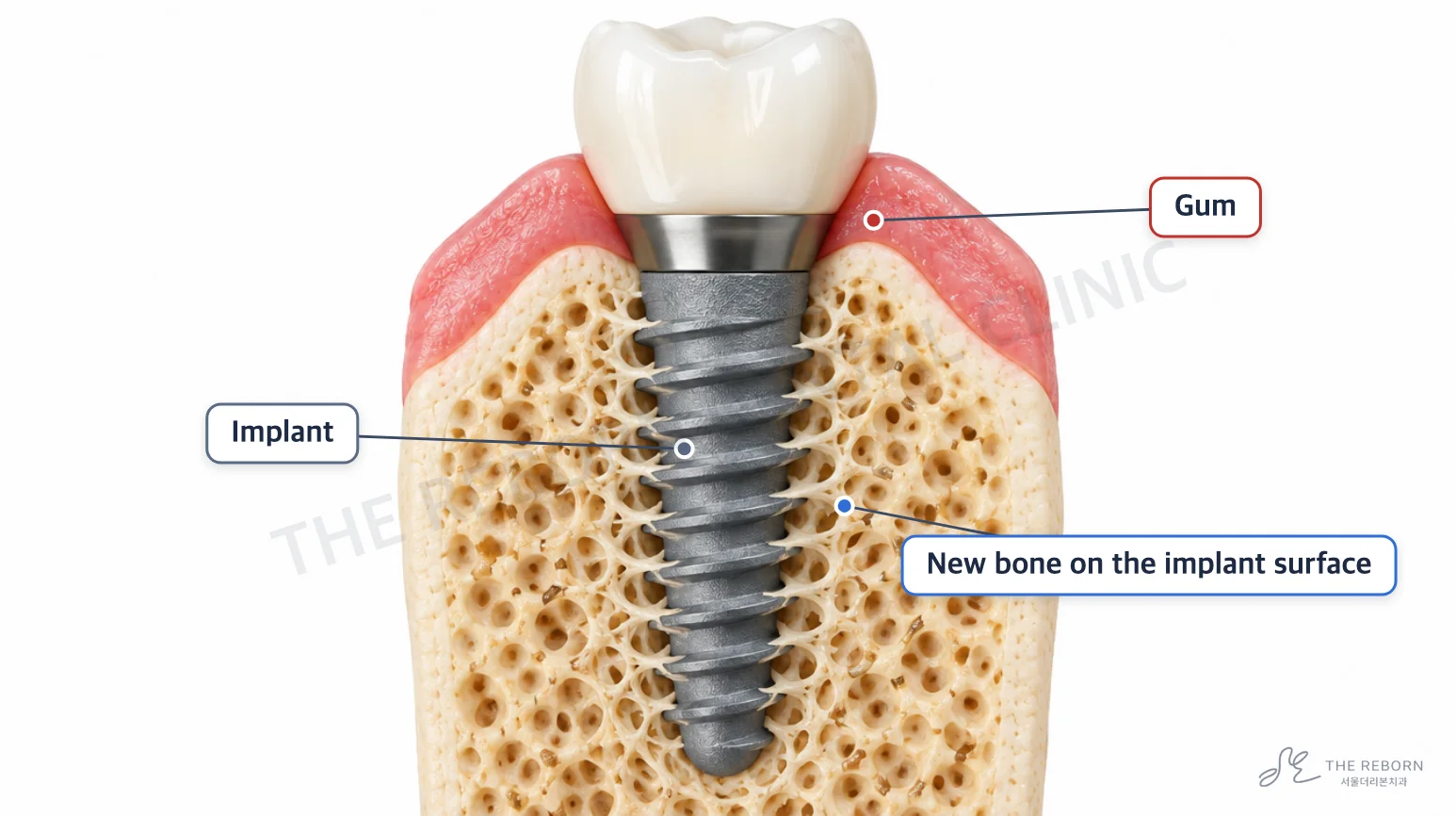
The catch is that the first grip slowly weakens, while new bone takes time to form.
A clinical study published in 2017 measured the stability of 35 implants in 20 people repeatedly over 10 weeks.
Stability is measured by attaching a small rod to the implant and using vibration. A higher number means the implant is held more firmly.
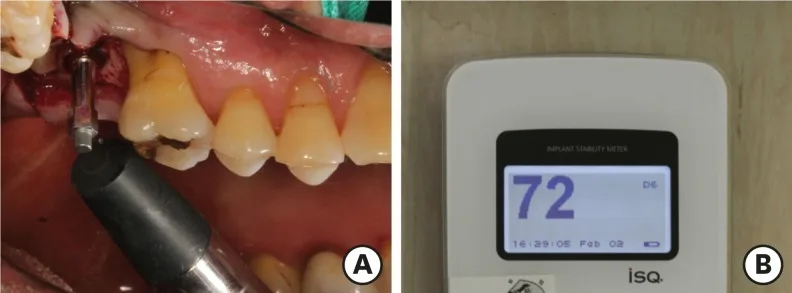
Stability was lowest 1 to 2 weeks after placement, and then rose gradually.
The study was small and used specific products, so it can't be applied to every case. Still, it shows why too much force should be avoided early on.
That is why, during healing, patients are asked not to chew hard food on the implant side.
Is the healing time different for the upper and lower jaw?
Even for the same implant, the waiting time can differ depending on where it is placed.
The lower jaw tends to have more dense bone, while the upper jaw, especially around the back teeth, tends to have more loose, spongy bone.
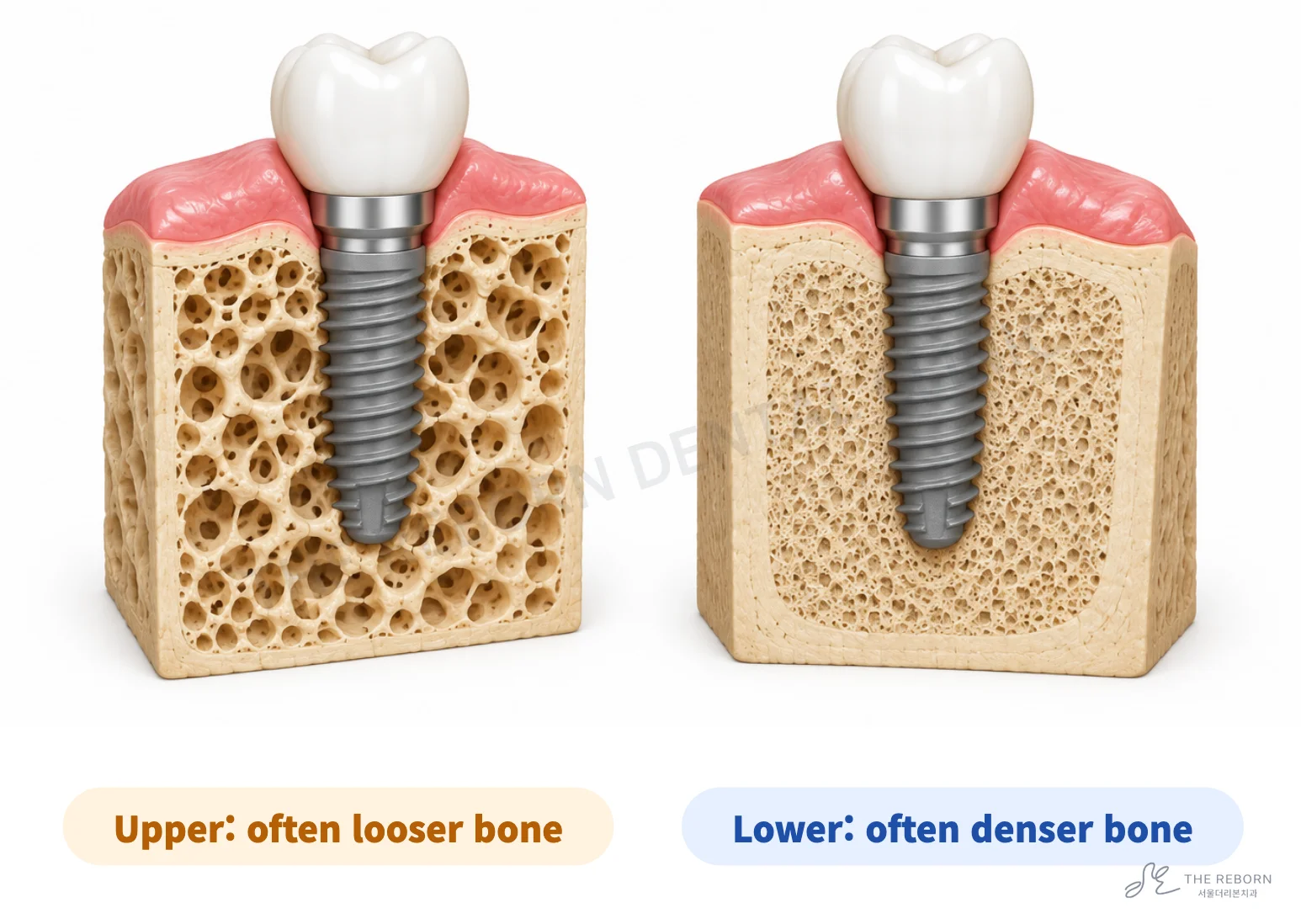
In the 2017 study above, implants in the lower jaw also had higher stability than those in the upper jaw throughout the observation period.
Among the studies included in a systematic review published in 2026, some waited 3 to 4 months in the lower jaw and 6 months in the upper jaw before attaching the crown.
These numbers are how individual studies were run, not a fixed rule.
The actual time is decided by the condition of the bone seen on CT and how firmly the implant is held when it is placed.
Whether healing is complete is not judged by time alone. X-rays and the stability of the implant are checked together before moving on to the next stage.
Is it faster to place the implant on the day of extraction?
If a tooth needs to be removed, when the implant is placed changes the overall length of treatment.
| Timing | Time after extraction | Features |
|---|---|---|
| Immediate placement | On the day of extraction | Can reduce the number of surgeries and the overall time |
| Early placement | 4–8 weeks or 12–16 weeks | Placed after the gum or bone has partly healed |
| Delayed placement | After 6 months | Placed after the bone has fully healed |
A retrospective study published in 2025 analysed 50,333 implants placed at 10 university dental hospitals.
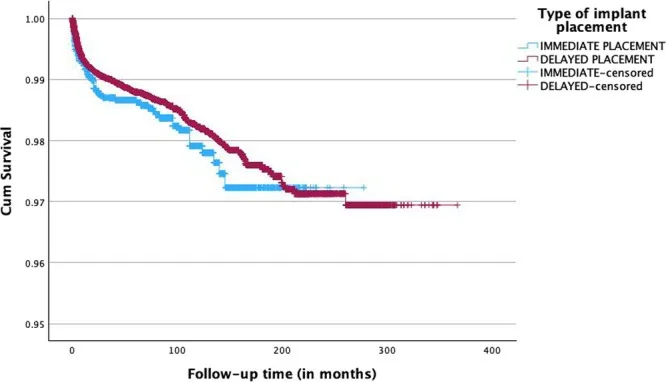
However, this study looked back at treatment records, and immediate placement may have been done only in cases that were well suited to it.
Where there is severe inflammation or much of the bone wall is gone, it may be better to wait for healing before placing the implant. The faster method does not suit everyone.
Can a tooth be attached right after the implant is placed?
The timing for attaching the crown after placement is also divided into three types.
| Type | When the crown is attached |
|---|---|
| Immediate loading | Within 1 week of placement |
| Early loading | Between 1 week and 2 months |
| Conventional loading | After 2 months |
A 2026 systematic review looked at 140 studies and 10,456 implants, grouped by the combination of placement timing and crown timing.
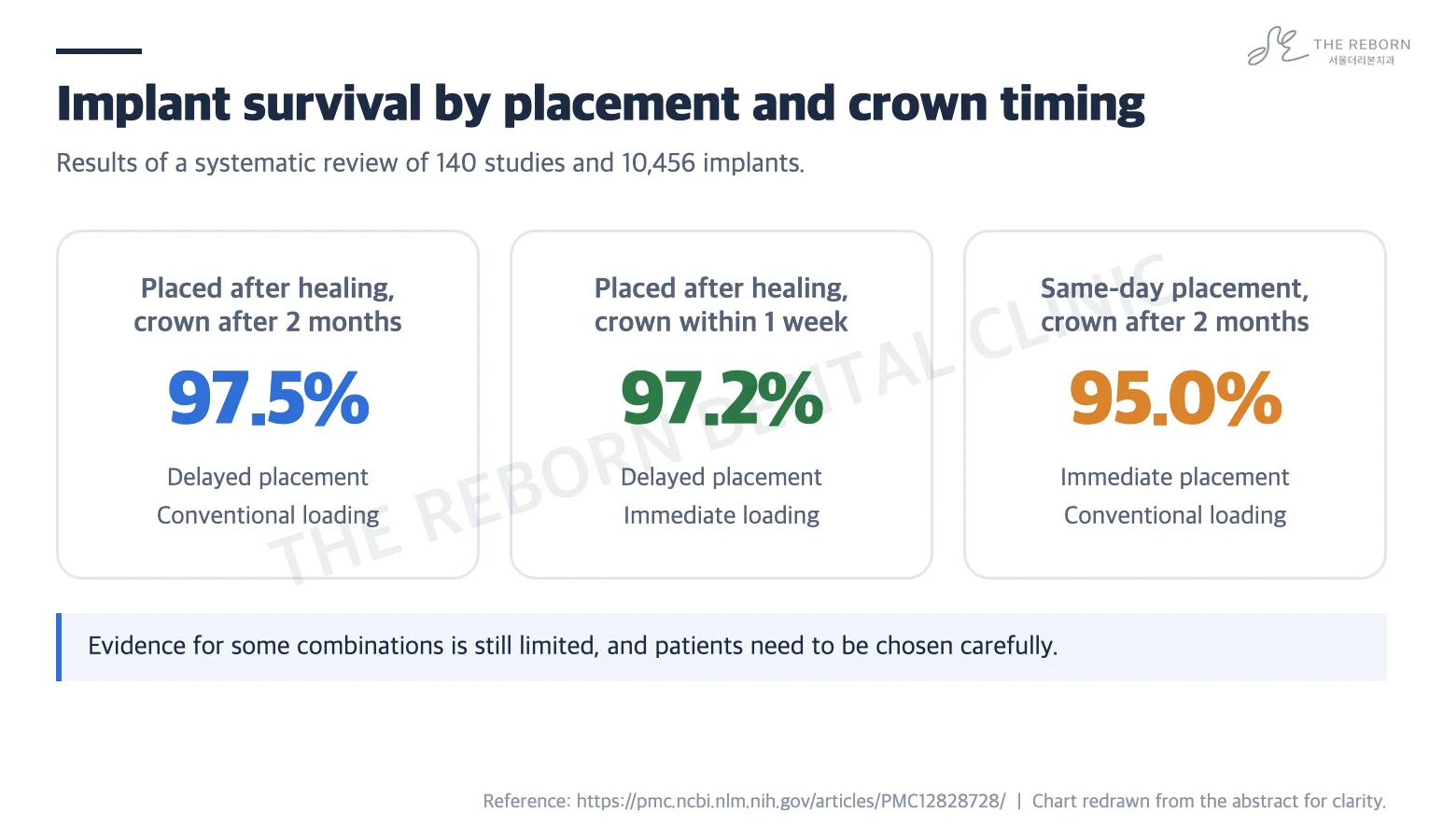
The numbers may not look very different, but the authors concluded that the evidence for some combinations is still limited, and that patients need to be chosen carefully.
Immediate loading usually means attaching a temporary tooth.
It can only be considered when the implant is held firmly in the bone at placement. If the implant moves even slightly early in healing, it can get in the way of the bone bonding to it.
A randomised clinical trial published in 2026 compared 16 people with implants in the upper front teeth and premolar area, split into immediate loading and loading after 6 months.
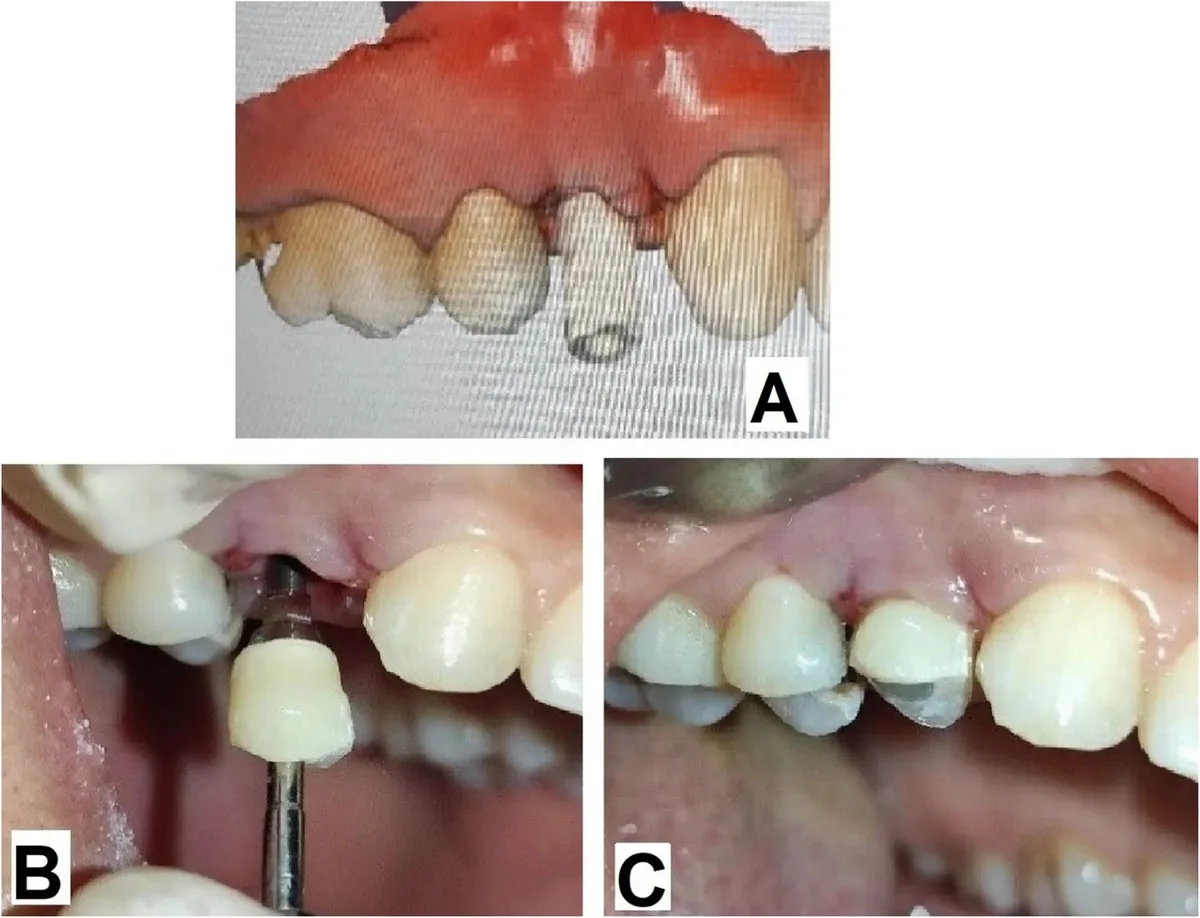
In the immediate loading group, the temporary teeth were made a little lower so they would not press hard against the opposing teeth. After 6 months, stability was similar in the two groups.
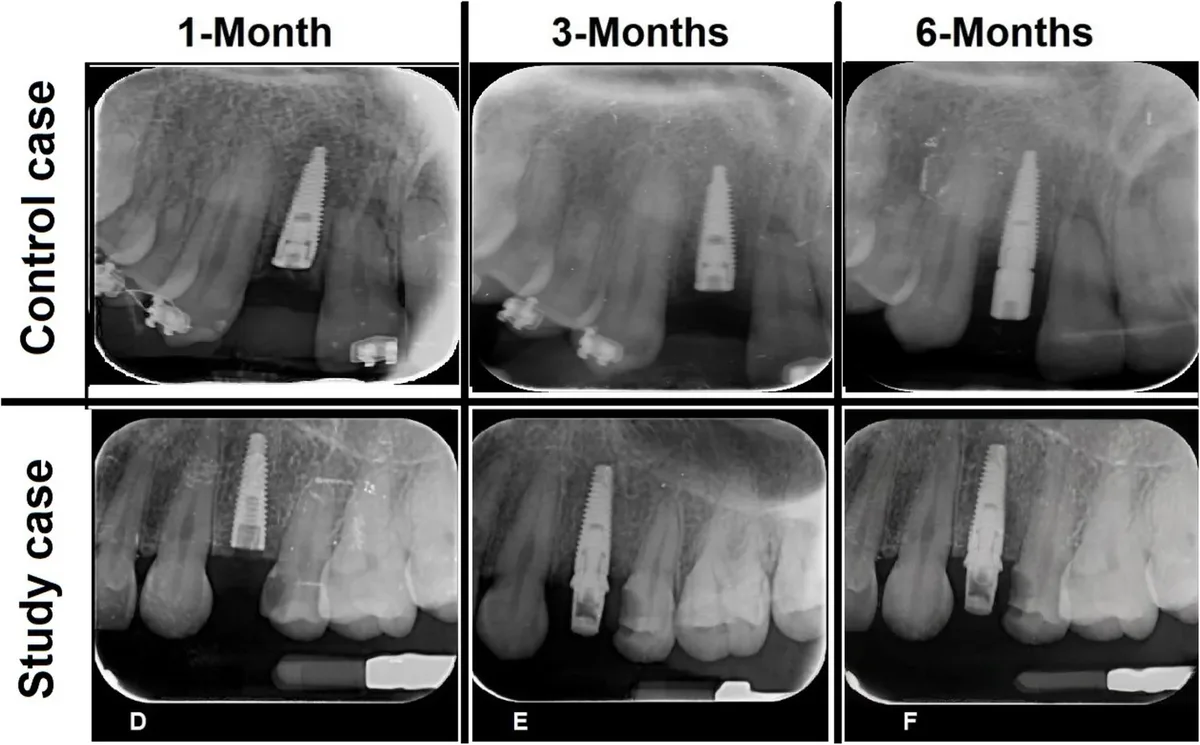
With only 16 people and follow-up to 6 months, the results can't be widely applied.
A temporary tooth is there for appearance, so you should avoid chewing on it.
When does treatment take longer?
There are a few reasons why implant treatment can take longer than expected.
The most common is when bone is lacking and a bone graft has to be done at the same time or beforehand.
Time is then needed for new bone to form in the grafted area, which adds to the healing period.
| Situation | Reason |
|---|---|
| A bone graft is needed | The grafted area needs time to heal |
| Areas with looser bone, such as upper back teeth | Bonding with the bone may take longer |
| Gum inflammation is still present | The inflammation is treated first |
| Factors that affect healing, such as diabetes or smoking | Healing may be slower |
At the crown stage, the number of visits can also increase while waiting for the gum shape to settle or while adjusting the bite.
While waiting for healing, front teeth and other visible areas often get a temporary tooth, while back teeth are usually left empty.
During this time you still come in on the scheduled days, so the dentist can check that the gum is healing well and that any temporary tooth isn't pressing too hard.
Because smoking can affect healing, patients are advised to cut down, at least during this period.
To make the crown, an impression is taken or the shape is recorded with an intraoral scanner. Once the finished crown is attached, the bite and the contact with the neighbouring teeth are adjusted.
Even after that, regular check-ups look at whether the screw has loosened and whether there is any gum inflammation.
More important than shortening the overall time is moving on to each next stage only after enough healing.
How long implant treatment takes can differ from person to person, depending on the condition of the bone, where the implant is placed, whether a tooth needs to be removed, and when the crown is attached.
A faster method is sometimes possible, but it is considered only when conditions are right, and in some cases it is better to wait long enough.
At our clinic, we check the amount and condition of the bone with CT and then go through the expected time for each stage with you.
If worry about the length of treatment has made you put it off, having your bone checked can show what your own schedule is likely to be.
Email us at rbdent@naver.com and Dr. Park will reply personally. You can also call 031.225.1410 (+82-31-225-1410) during opening hours. We are near Suwon City Hall Station — directions.
- Implant stability over the first 10 weeks — prospective clinical study (2017)
- Implant placement and loading timing — systematic review (2026)
- Immediate vs. delayed implant placement — retrospective study (2025)
- Immediate vs. 6-month loading — randomised clinical trial (2026)
This article is general health information about how long dental implant treatment takes and its stages, not a diagnosis. The actual length and method of treatment depend on the amount and condition of your jawbone, whether a tooth needs to be removed, and your general health. Research results describe what was observed under each study's conditions and do not guarantee any individual outcome.