26 November 2026 · 6 min read
Receding Gums Treatment: Can Receding Gums Grow Back?
By Dr. Park Junsun, Korean board-certified specialist in Integrated Dentistry
Hello, I'm Dr. Park Junsun, director of The Reborn Dental Clinic in Suwon.
Have you ever looked in the mirror and felt that your teeth look longer than they used to?
When cold water makes your teeth sensitive, or the gaps between your teeth seem wider, you may worry that your gums are receding.
The questions I hear most are whether receded gums can grow back, and whether receding gums really need treatment.
In this article I'll go through why gums recede, how to look after them, and when a gum graft may be considered.
- When gums recede, the root surface is exposed, which can lead to sensitivity, root decay and wear near the gumline.
- The main causes are gum inflammation from plaque and brushing habits such as scrubbing too hard.
- Receded gums are unlikely to grow back to their original height on their own, so the first step is to reduce the causes so it doesn't get worse.
- A gum graft may be considered in some cases, but the root cannot be fully covered in every case.
What happens when gums recede?
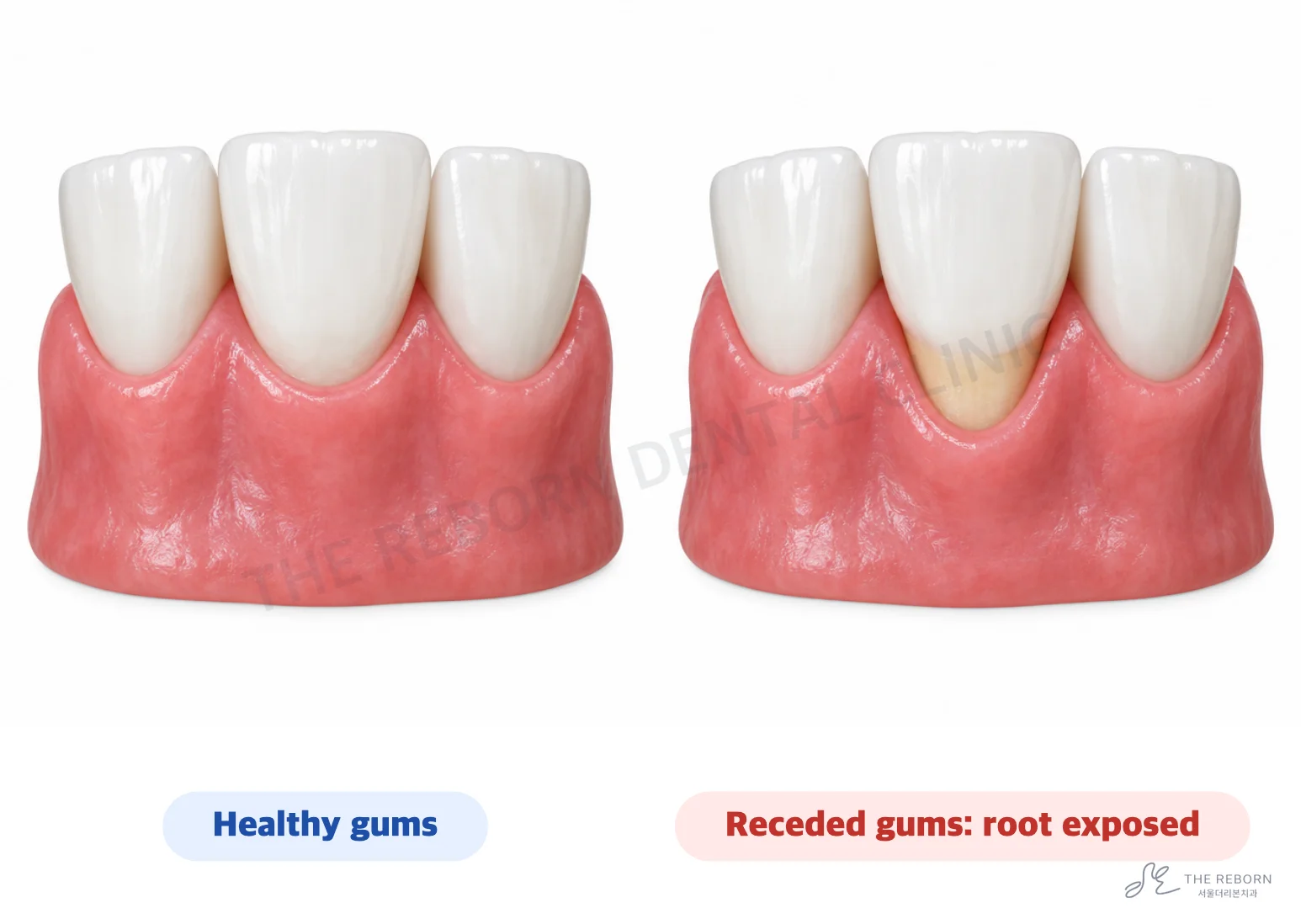
Receding gums means the edge of the gum moves down toward the root of the tooth, so the root surface becomes exposed. Dentists call this gingival recession.
The root surface is not covered by hard enamel, so it is prone to sensitivity to cold, to decay, and to being worn away by brushing.
A 2021 review also listed sensitivity, root decay, notches worn at the neck of the tooth, and concerns about appearance as problems that come with gum recession. As a review, it summarises earlier research rather than reporting a new study.
It isn't rare, either. A 2021 study in Greece examined 104 people aged 18 to 30 and found at least one tooth with receded gums in more than half of them (53.8%).
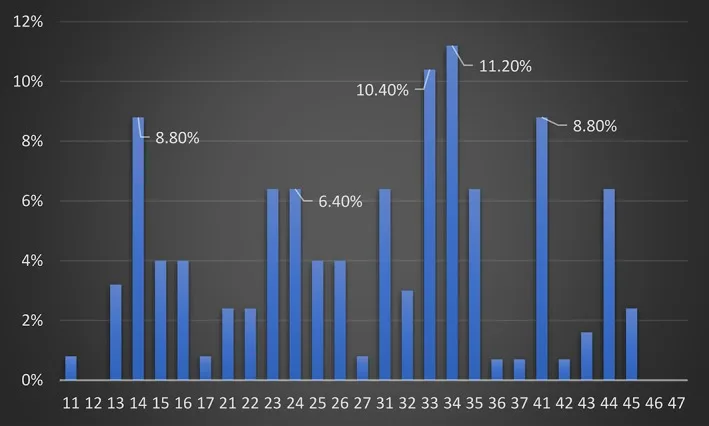
It was seen most often at the lower left canine and first premolar.
This study looked at 104 young adults in one country, so its results can't be applied directly to other places, but it shows that gum recession can happen even at a young age.
Why do gums recede?
There is usually no single cause. In many cases, several factors overlap.
The 2021 review named gum inflammation caused by plaque and poor brushing habits as the most important causes.
| Type | Details |
|---|---|
| Built-in factors | Thin gums, or only a narrow band of firm gum |
| Inflammation | Gum inflammation and periodontitis caused by plaque build-up |
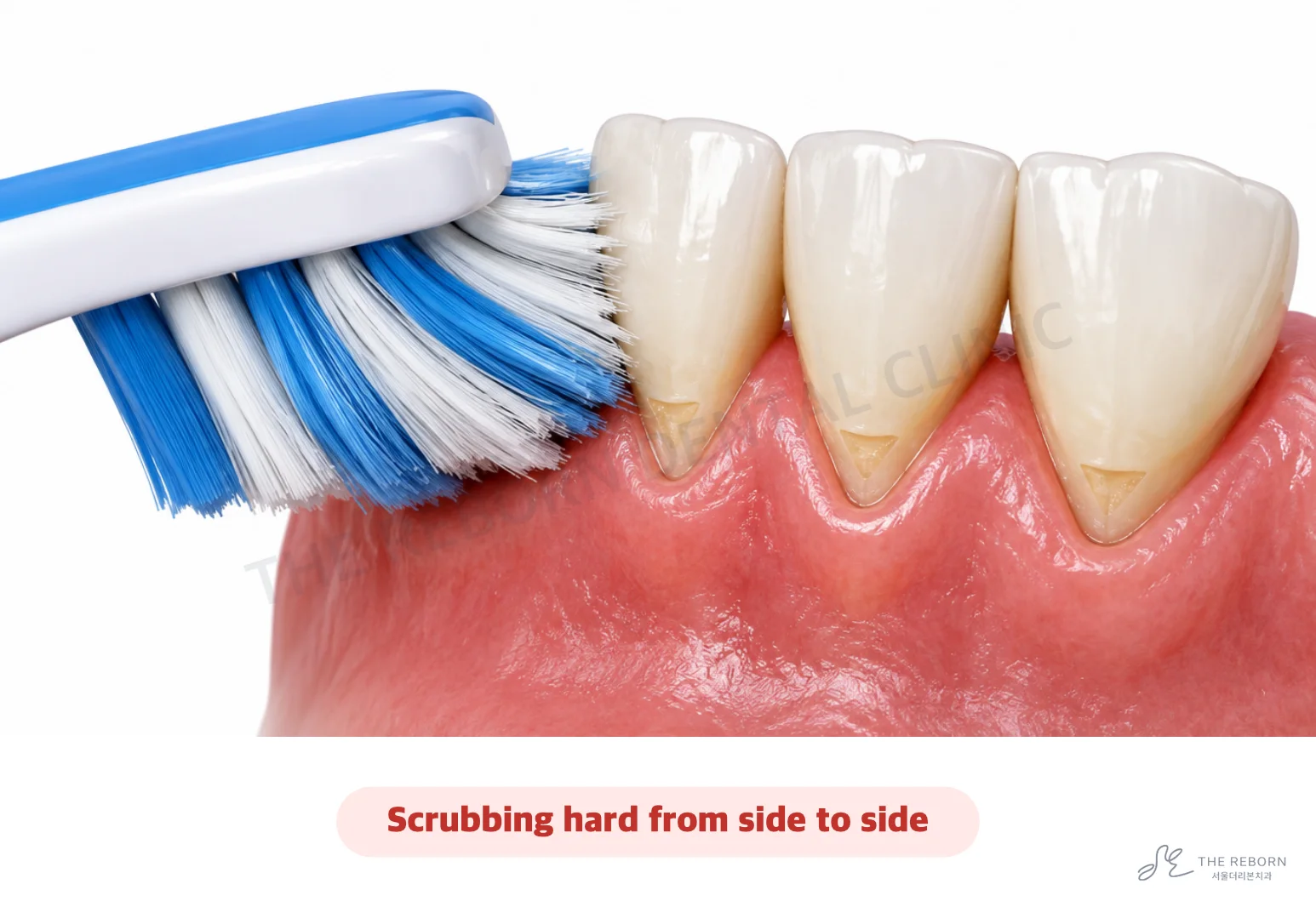
| Habits | Scrubbing hard when brushing, smoking |
| Other factors | Crown edges that sit below the gumline, diabetes |
When periodontitis causes the jawbone to shrink and the gum goes down with it, the problem is linked to bone loss from gum disease, so treating the inflammation comes first.
On the other hand, gums can also recede without any inflammation, when thin gums are combined with hard brushing.
That doesn't mean brushing itself is the problem. In a 2025 randomised trial that followed 87 people with gum recession for three years, the share of sites where the gum went down by 1 mm or more was 25.5% in the manual toothbrush group and 10.6% in the power toothbrush group.
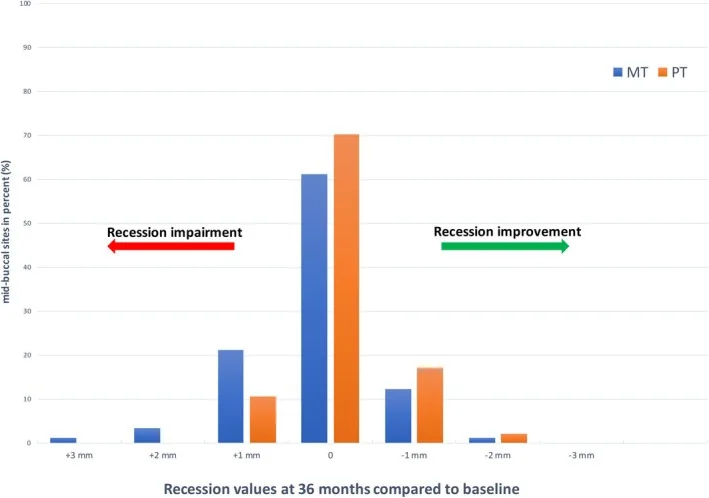
Most sites stayed the same or improved over the three years.
The study used one particular power toothbrush and did not teach participants a specific brushing method, so it can't show that one type of toothbrush is better.
It is best read as a sign that how hard and how you brush matters more than the type of toothbrush.
Can receded gums grow back?
Many people hope so, but once gums have receded, it is unlikely they will grow back to their original height on their own.
The 2021 review also explained that gum recession that is left untreated tends to get worse over time.
So the first step in treating receding gums is to reduce the causes, so that the gums don't recede any further.
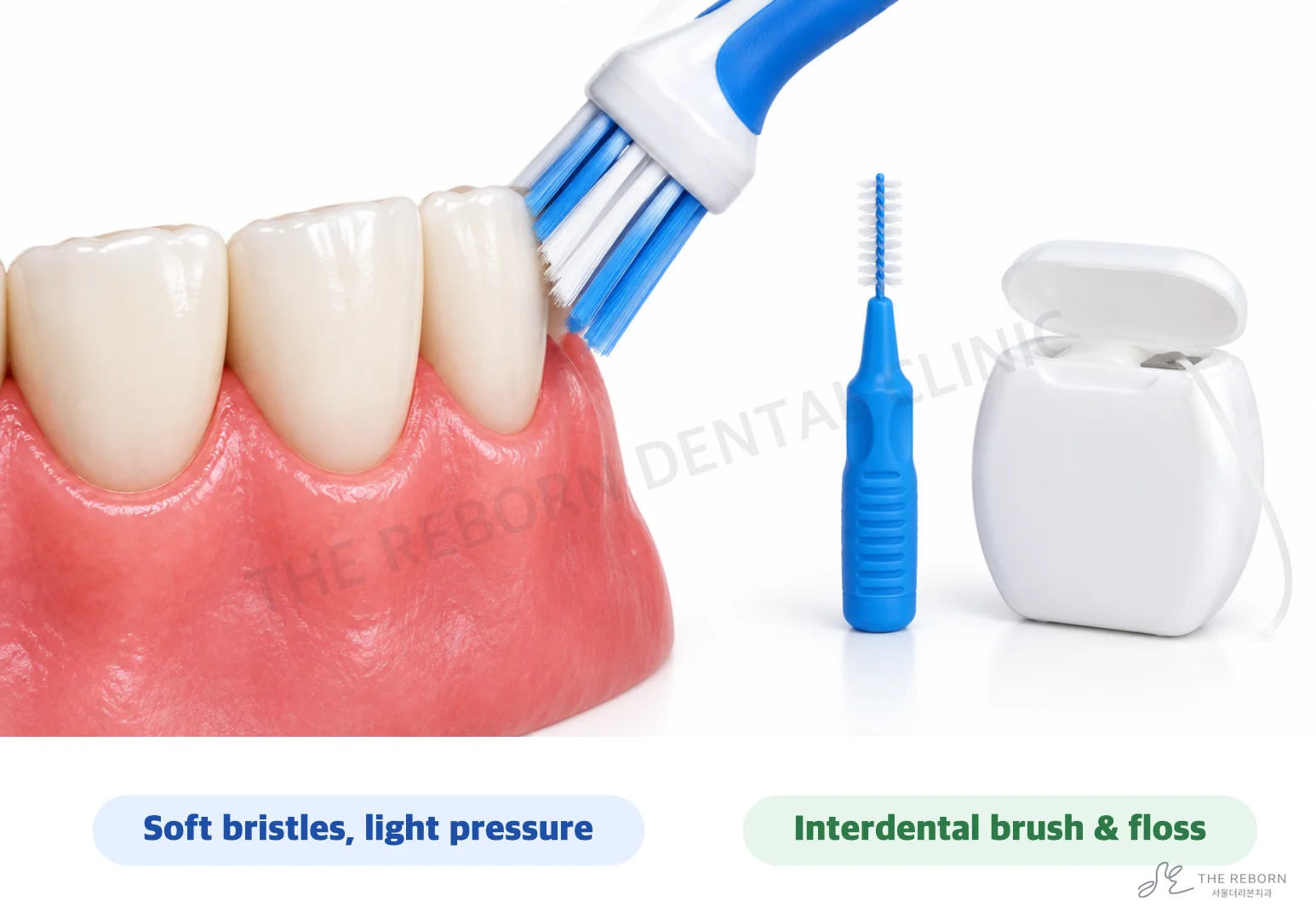
| Care | How |
|---|---|
| Brushing | Use soft bristles and don't press hard |
| Toothpaste | Choose a low-abrasion toothpaste |
| Managing inflammation | Plaque control and regular scaling (professional cleaning) |
| Sensitivity | Toothpaste for sensitive teeth; if needed, a surface treatment at the dental clinic |
With this kind of care, the gums often stay where they are.
In a randomised trial published in 2016, adults with gum recession kept brushing twice a day for 2 minutes over three years.
The average depth of recession went from 2.26 mm to 1.81 mm in the manual toothbrush group, and from 2.35 mm to 1.90 mm in the power toothbrush group.
However, the participants were in good general health, and these figures were calculated by subtracting one probe measurement from another, so they don't mean that exposed roots were covered again.
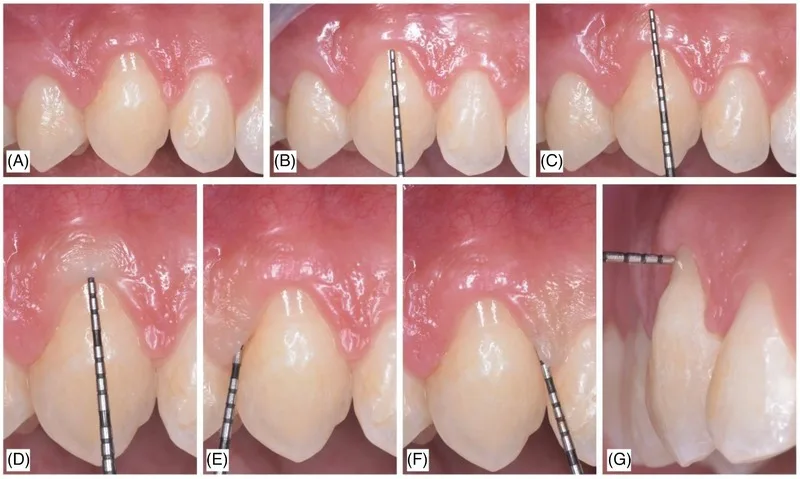
How far the gum has receded is recorded together with the condition of the gum between the teeth, and compared at each check-up.
When is a gum graft considered?
A gum graft may be considered if the gum keeps receding despite good care, if sensitivity doesn't settle, or if the appearance bothers you a lot.
A widely used method is to move the gum up to cover the exposed root and to add tissue taken from the roof of the mouth underneath it.
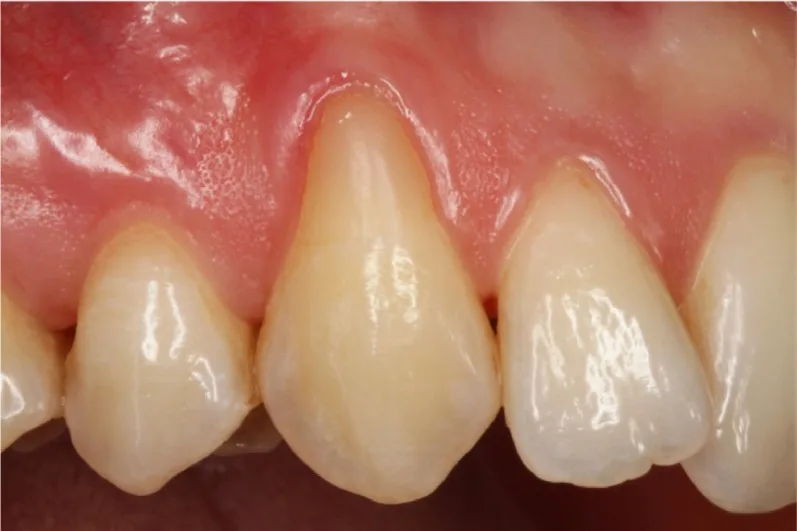
However, it is not possible to cover the root completely in every case.
| Type | Gum between the teeth | What to know |
|---|---|---|
| Type 1 | The gum between the teeth is intact | Favourable when planning treatment to cover the root |
| Type 2 | The gum between the teeth has also receded in part | The root may be only partly covered |
| Type 3 | The gum between the teeth has receded more than on the outer side | Covering the root completely tends to be difficult |
The 2021 review explained that results tend to be less good when the recession is deeper, the gum is thinner, or the gum between the teeth has receded.
In a randomised trial published in 2023, 43 areas of recession in 24 people who had gum grafts were checked again five years later.
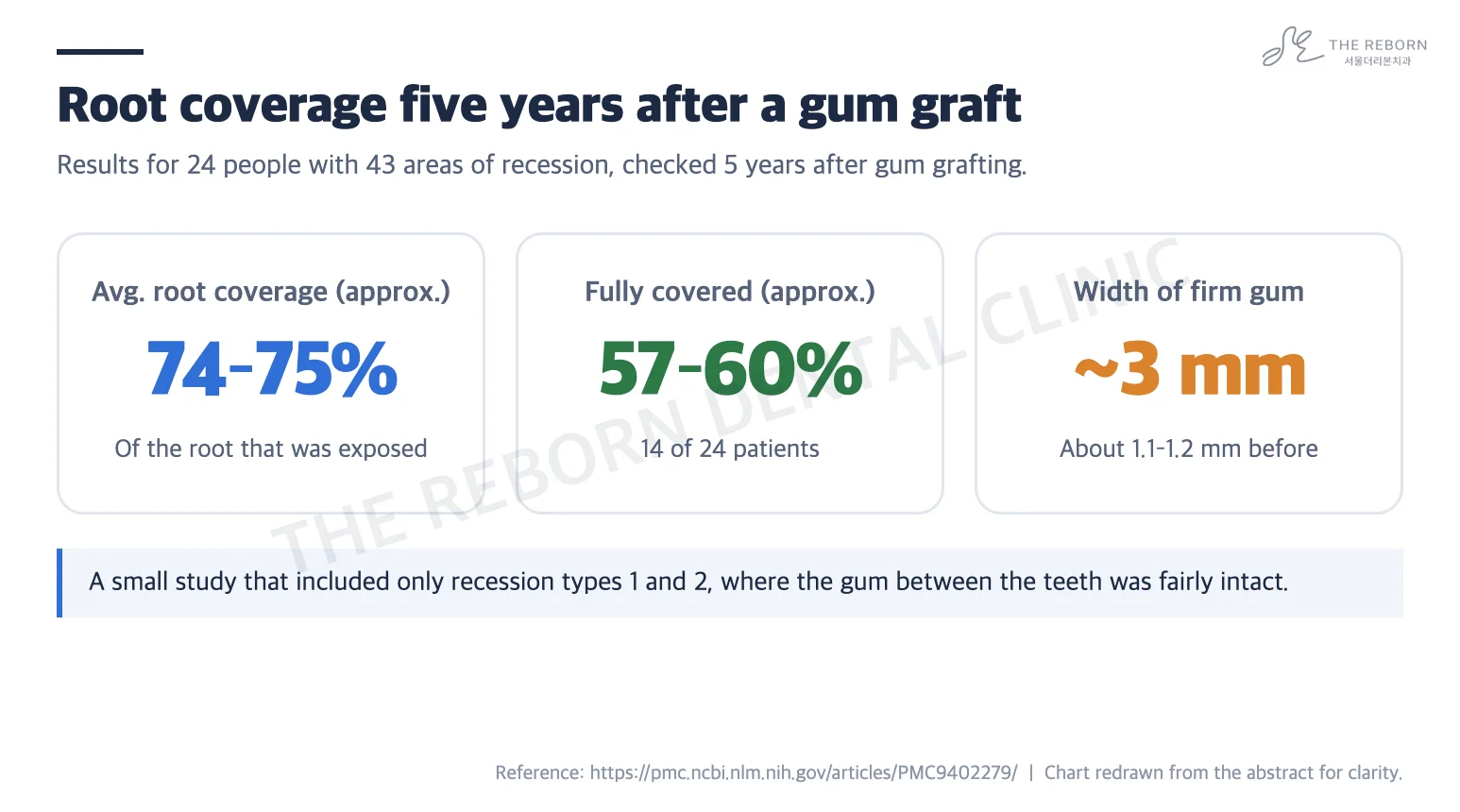
The study was small, with only 24 people, and included only type 1 and type 2 recession, so the same results can't be expected for everyone.
With receding gums, whether the recession is still progressing and what is causing it matter more for choosing a treatment than how far the gum has already gone down.
Even if the gums have receded to the same level, the care you need can differ depending on whether the cause is inflammation or brushing.
At check-ups at our clinic, we record the depth of recession, the gum thickness and the condition of the gum between the teeth, and check together whether they change over time.
If your teeth look longer or the sensitivity keeps going, it's better to have your gums checked than to put it off.
Email us at rbdent@naver.com and Dr. Park will reply personally. You can also call 031.225.1410 (+82-31-225-1410) during opening hours. We are near Suwon City Hall Station — directions.
- Gingival recession: causes and treatment — review (2021)
- Gum recession in young adults in Greece — cross-sectional study (2021)
- Power vs manual toothbrush in gum recession — randomised trial (2025)
- Toothbrushing and gum recession over 3 years — randomised trial (2016)
- Measuring gum recession — clinical article (2025)
- Gum grafting results after 5 years — randomised trial (2023)
This article is general health information about the causes, care and treatment of receding gums (gingival recession), not a diagnosis. Whether you need treatment, and which kind, depends on how far the gum has receded, how thick the gum is and whether there is inflammation. Research results describe what was observed under each study's conditions and do not guarantee any individual outcome.