Case notes
Most of the bone around the implants had been lost, leaving them loose, with the surrounding gum tissue badly damaged as well
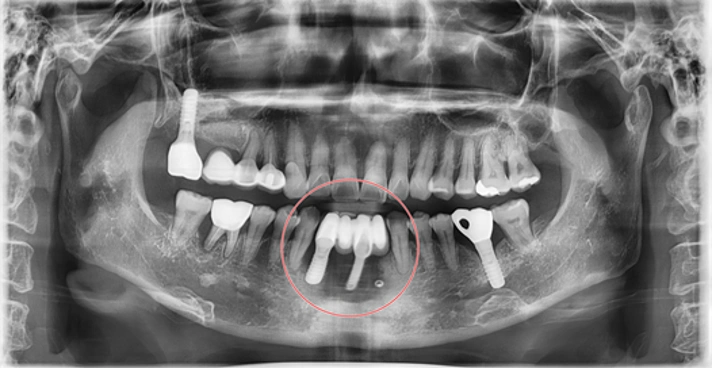
[Initial panoramic X-ray] The area circled in red is the site requiring treatment
This is a revision case involving lower front implants originally placed at another clinic. There are various reasons an implant has to be redone; here, most of the bone around the implants had been lost, leaving them loose, and the surrounding gum tissue was badly damaged too. Removing implants in this state is straightforward — the bone around them has already gone — but what really determines success is how well the severely damaged bone can be rebuilt afterwards.
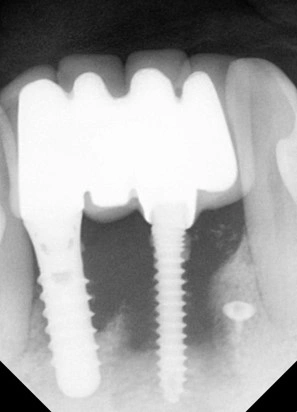
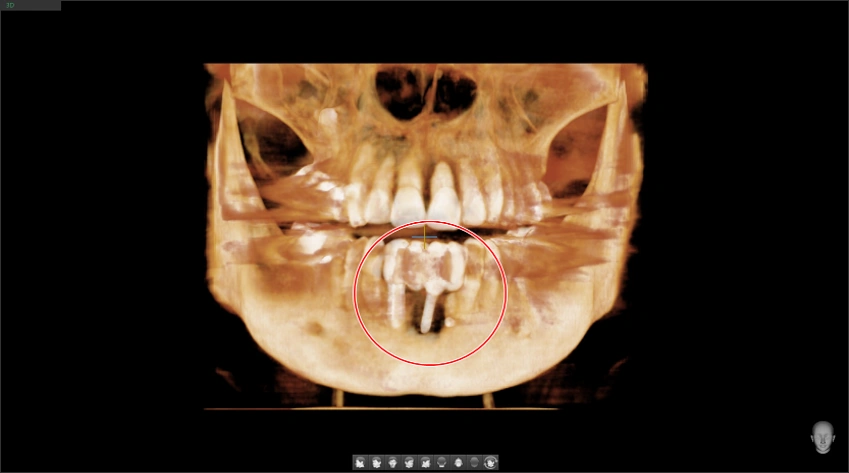
Bone grafting to regenerate damaged bone, or to build up bone where there is too little, is in fact a very common procedure. But where inflammation has been as severe as it was here, the tissue's capacity to heal is much reduced and the volume of bone to be rebuilt is considerable — so the work is technically harder than usual and takes longer. In the initial X-ray you can see the two lower front implants, with the bone around them entirely gone and appearing dark on the film. Healthy bone should look white and hazy. Judging by the traces of earlier treatment, this site had already been grafted extensively before.
We decided to remove both existing implants and the restoration, and to carry out bone regeneration at the same time. Where a reasonable amount of bone remains, a new implant can be placed simultaneously — but here so much bone needed rebuilding that we planned to graft first and place the implants later. Successful bone grafting draws on a good deal of know-how, and a case like this is among the most demanding, so careful surgical planning and the right choice of material matter a great deal.
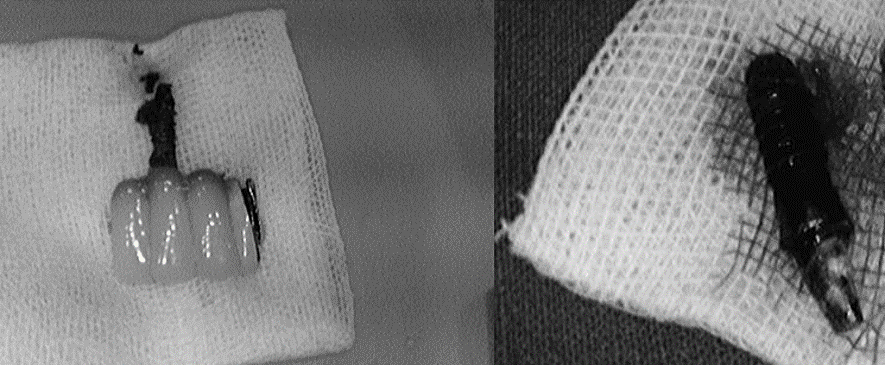
Under local anaesthetic, the existing implants and all inflamed tissue were removed and the bone graft placed. Setting aside the time waiting for the anaesthetic to take effect, the surgery took around thirty minutes. Because these are front teeth, where appearance matters, the patient cannot go without teeth while the bone heals. We make a temporary tooth, and in most cases it is fixed rather than removable, so day-to-day life is barely affected. The temporary is fragile, though, so please do not bite into food with the front teeth.
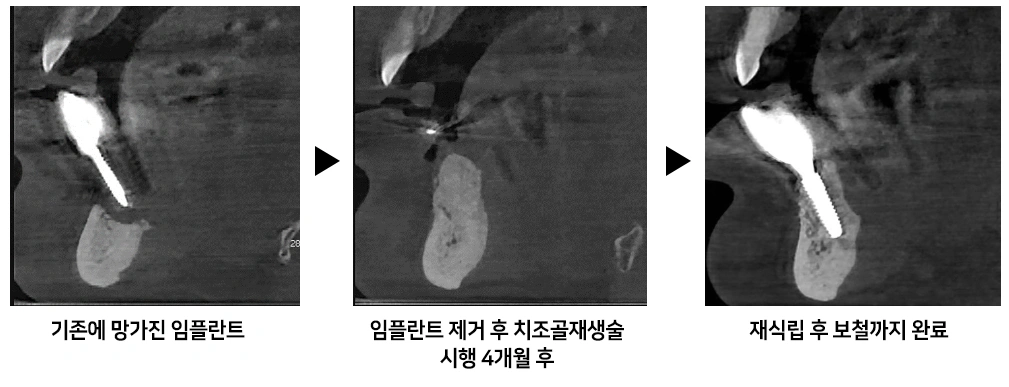
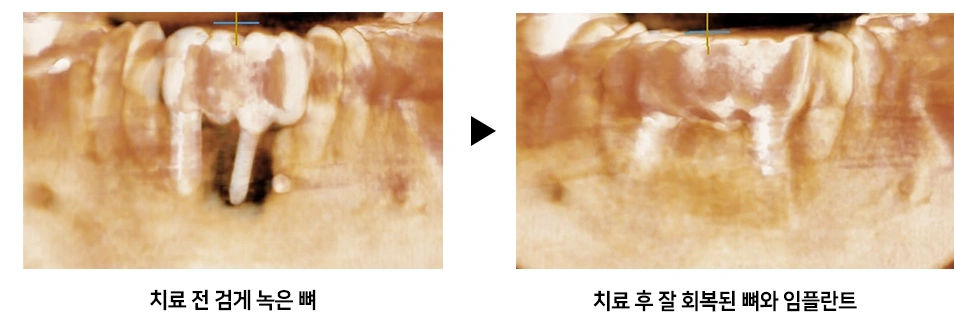
As the images show, the bone regenerated well, and over time the grafted bone can be seen maturing as it should. With regular check-ups and good oral hygiene from here, these implants should last a very long time.
This is something I always stress to patients: timing really matters in dentistry. I see so many cases where what could have been solved simply, had the patient come at the right moment, ends up demanding far more effort, time and cost. Implants are no different. Placing one is not the end of the story — regular check-ups and proper care are what prevent revision surgery like this.
These are actual cases treated at our clinic. Results vary from person to person, and side effects may occur.