Case notes
A patient being treated for osteoporosis: bone grafting and implant placement completed in a single procedure
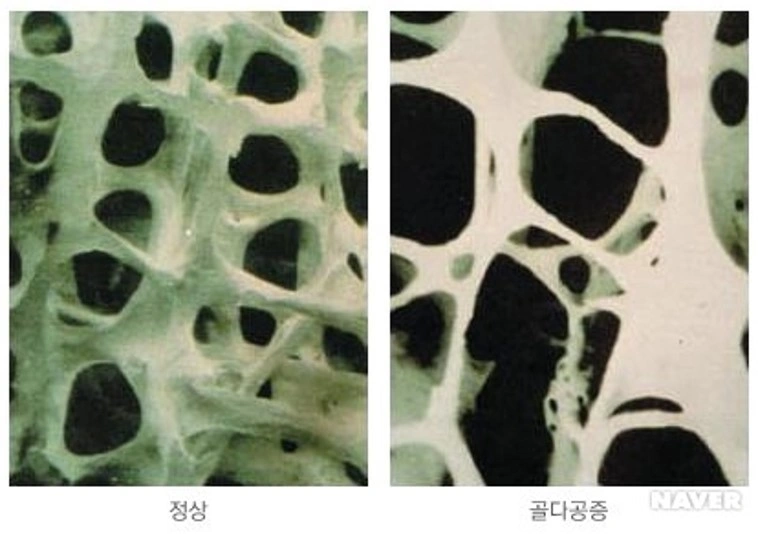
Osteoporosis in itself presents no particular obstacle to placing an implant, beyond the fact that the bone has more empty space and is weaker, which makes initial stability harder to achieve. In other words, implants are possible. Care is needed, however, if you are taking or being injected with medication for osteoporosis. Not all such drugs are a problem, but one particular class can, in a very small number of cases, cause serious complications during dental treatment. That is why the initial questionnaire at a dental clinic asks whether you take osteoporosis medication — to head off any problem in advance. Osteoporosis drugs vary, but bisphosphonates cause difficulty when given intravenously, or when taken orally over several years or more. They are bone resorption inhibitors that prevent loss of bone density, and after procedures that injure the jawbone — extraction or implant surgery — they have been shown to cause necrosis of the jaw in a very small proportion of cases (0.01%–4%).
So does being treated for osteoporosis mean you cannot have an implant? Not at all. We draw on our own experience to keep the possible complications to a minimum. By discussing a change of medication properly with the physician managing your osteoporosis, and by approaching the implant or graft surgery in a way that minimises complications, treatment is possible without difficulty in the great majority of cases.
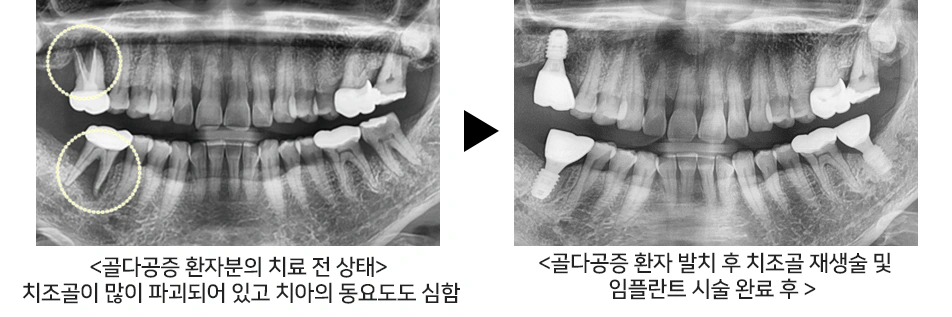
The images above show a patient who came in with bone loss already advanced to the root tip. She had understood that being treated for osteoporosis made implants difficult, but with the right precautions the bone regeneration and implant placement were completed in a single procedure — and after the restoration you can see the regenerated tissue and the well-placed implant settled without any problem.
It is true that patients with osteoporosis need more careful preparation before an implant, but as this case shows it is far from impossible. Many people put off coming to the dentist out of fear — yet rather than letting things worsen while you wait, it is much better to come early, get an accurate diagnosis, and plan treatment accordingly. I will keep working and studying so that everyone who comes to me can leave with hope that treatment is possible.
<What to check before treatment if you are taking osteoporosis medication>
1. Be sure to tell your dentist that you are taking the medication.
2. Confirm exactly which drug you are taking.
3. If it is one of the drugs of concern, change it or pause it for a period, under your physician's guidance.
These are actual cases treated at our clinic. Results vary from person to person, and side effects may occur.